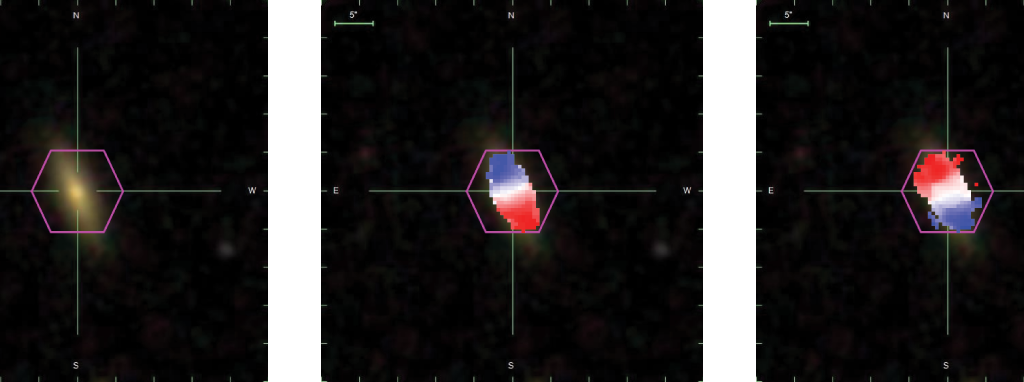
Astronomers have discovered that many small galaxies hosting active supermassive black holes have their stars and gas spinning out of sync – sometimes in completely opposite directions.

This page shows our official press releases announcing discoveries during the current fifth phase of the SDSS. For more discoveries, see the press releases of the previous generations of the SDSS, listed at the bottom of this page.
Astronomers have discovered that many small galaxies hosting active supermassive black holes have their stars and gas spinning out of sync – sometimes in completely opposite directions.

A new study from the Sloan Digital Sky Survey has revealed a surprising truth about black holes: they spin faster than previously thought, revealing a more orderly early universe than we ever suspected.
The Sloan Digital Sky Survey (SDSS) is embarking on its most innovative spectroscopic survey yet of our Milky Way: creating a comprehensive map of the interstellar material in our Galaxy.

A student-led team has observed that the mass-radius relation of white dwarf stars, a type of star which is so dense that they are supported by quantum mechanical effects, depends on the temperature of the star. Scientists have long searched for this subtle effect, detected here for the first time using a method from General Relativity – along with the largest catalog of white dwarf data of its kind.
Read MoreSDSS astronomers observe theoretically predicted effect in the remnants of dead stars

A team of astronomers from the Sloan Digital Sky Survey (SDSS) has used eight years of careful, constant observations to discover unexpected changes in the winds surrounding a distant black hole.

Astronomy’s new blockbuster is now playing in New Orleans. Astronomers from the Sloan Digital Sky Survey (SDSS) have discovered evidence for what they call the “Barbenheimer Star” – an enormous ancient star that exploded in a way previously thought impossible, resulting in an unusual pattern of elemental ashes that left behind a trail of evidence still visible billions of years later.
Read MoreThe “Barbenheimer Star”: Evidence for Spectacular Nucleosynthesis in the Early Universe

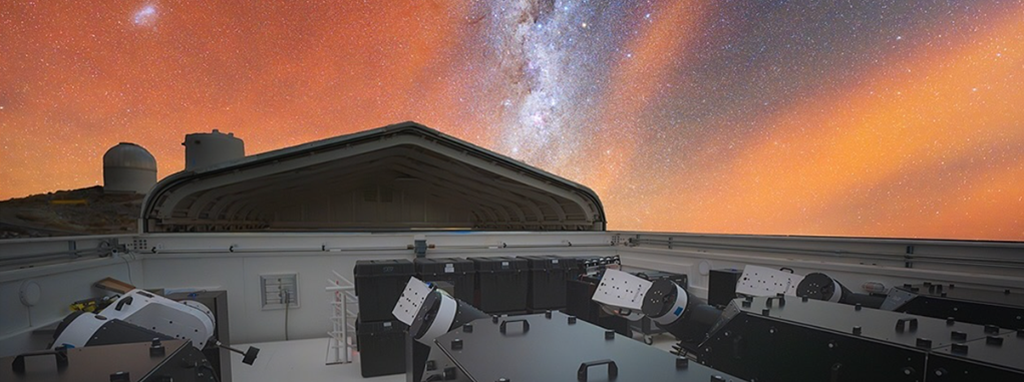
The newest mapmaking effort of the long-running Sloan Digital Sky Survey has begun. The Local Volume Mapper (LVM) Instrument has seen first science light.

After twenty-one years of observers loading heavy aluminum plates night after night, the Sloan Digital Sky Survey (SDSS) is now seeing the cosmos through robotic eyes.
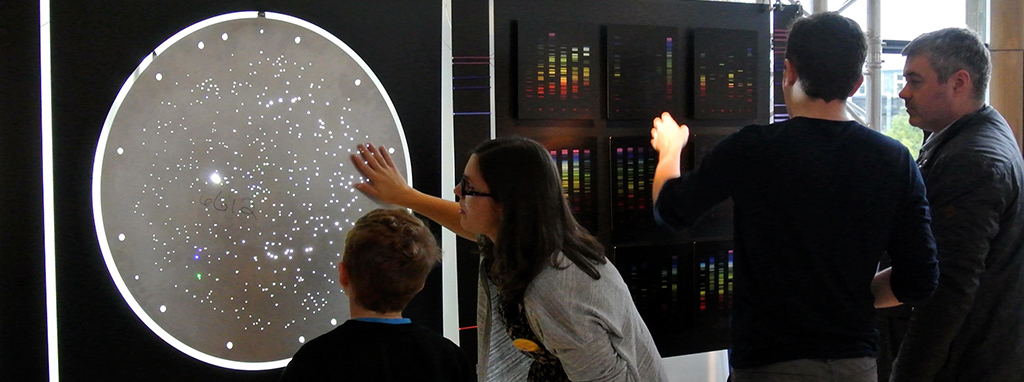
They may not look like much — just metal disks 80 centimeters (30 inches) across with some etched markings and hundreds of small holes — but round aluminum “plates” like this one from the Sloan Digital Sky Survey (SDSS) have been vital to mapping our universe for more than 20 years.

The Sloan Digital Sky Survey’s fifth generation collected its very first observations of the cosmos at 1:47 a.m. on October 24, 2020. As the world’s first all-sky time-domain spectroscopic survey, SDSS-V will provide groundbreaking insight into the formation and evolution of galaxies—like like our own Milky Way—and of the supermassive black holes that lurk at their centers.
For a list of press releases from previous generations of the SDSS, see the lists on their project websites: