
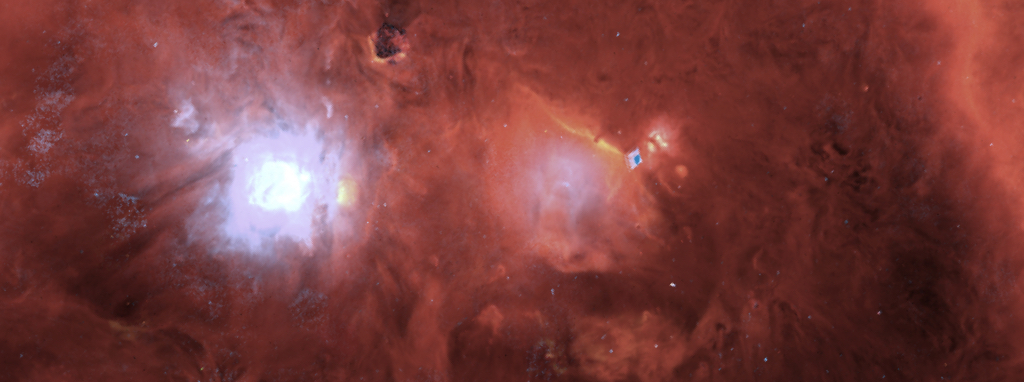
LAS CAMPANAS OBSERVATORY, CHILE — While the Milky Way appears from Earth as a serene, glowing band stretching across the night sky, zoom in closely and a picture of dynamic cosmic mayhem emerges. Galaxies are living, evolving ecosystems driven by the lifecycles of their stars. Massive stars are born in cold molecular clouds, live short, energetic lives, and flood their environments with intense ultraviolet radiation and powerful stellar winds before dying in violent supernova explosions.

Image Credit: SDSS-V Collaboration; Ivan Katkov, New York University Abu Dhabi
Contacts
Kathryn Kreckel
Heidelberg University
kathryn.kreckel@uni-heidelberg.de
Sebastián Sánchez
Universidad Nacional Autónoma de México
sfsanchez@astro.unam.mx
Ivan Katkov
New York University Abu Dhabi
ik52@nyu.edu
This process, known as stellar feedback, carves giant, glowing bubbles into the interstellar gas and dust, dictating how future generations of stars can form. Yet, understanding the physics governing these complex feedback loops has remained one of astrophysics’ biggest challenges because astronomical instruments usually have to choose between a wide view of a nebula or a detailed chemical breakdown of its gas.
Today, as part of Data Release 20 (DR20) of the fifth phase of the Sloan Digital Sky Survey (SDSS-V), astronomers are releasing a public preview of the Local Volume Mapper (LVM). Operating from the Chilean desert, LVM bridges this gap by capturing light to reveal the physics and chemistry of stellar birthplaces across vast expanses of the sky in unprecedented detail.
Small Telescope, Massive Vision
Operating since 2023, the LVM relies on an unconventional design: a compact set of 16-centimeter primary telescopes working in tandem with extraordinary wide-fields of view capable of capturing the entire full Moon in a single snapshot.
Despite its modest physical size, the instrument combines ultra-dense arrays of optical fibers into Integral Field Units (IFUs). Instead of taking standard two-dimensional photographs, LVM breaks the light at every point in the field into more than 10,000 individual color channels (spectra) simultaneously – a hyperspectral cube with 2 spatial and 1 spectral dimension.
By analyzing specific spectral lines—such as ionized sulfur ([S II]), hydrogen-alpha (Hα), and doubly-ionized oxygen ([O III])—astronomers can map the precise temperature, density, chemical abundance, and motion of interstellar gas across the gas in the Milky Way.
A Global Endeavor
SDSS-V is made up of hundreds of scientists across more than 70 institutions worldwide. While each phase is distinct, SDSS is committed to releasing public data as part of its core mission and is celebrating its 20th major public data release since its debut release in 2003. In addition to the LVM preview, DR20 delivers expanded spectroscopic datasets from the Milky Way Mapper (MWM)—tracing the structure and chemical history of millions of stars—and the Black Hole Mapper (BHM), which monitors supermassive black holes at the centers of distant active galaxies.
“These observations showcase the remarkable breadth and depth of LVM,” added Dr. Kathryn Kreckel, group leader at Heidelberg University and LVM Survey Scientist, “revealing the complex ecosystems of gas and stars in exquisite detail. With millions more spectra still to be collected, we are only beginning to explore the scientific opportunities this survey will provide.”
“Now it is time to scientifically exploit this enormous distributed dataset, exploring the interstellar medium at a range of physical scales never covered before, from resolved nebulae to entire galaxies, creating synergies with other surveys, incorporating multiwavelength explorations, and providing a deeper physical understanding of the new observations,” noted Dr. Sebastián Sánchez, professor at UNAM, LVM program head, and lead author on the recent Helix Nebula study.
A Tale of Two Nebulae: Key Discoveries by Early-Career Researchers
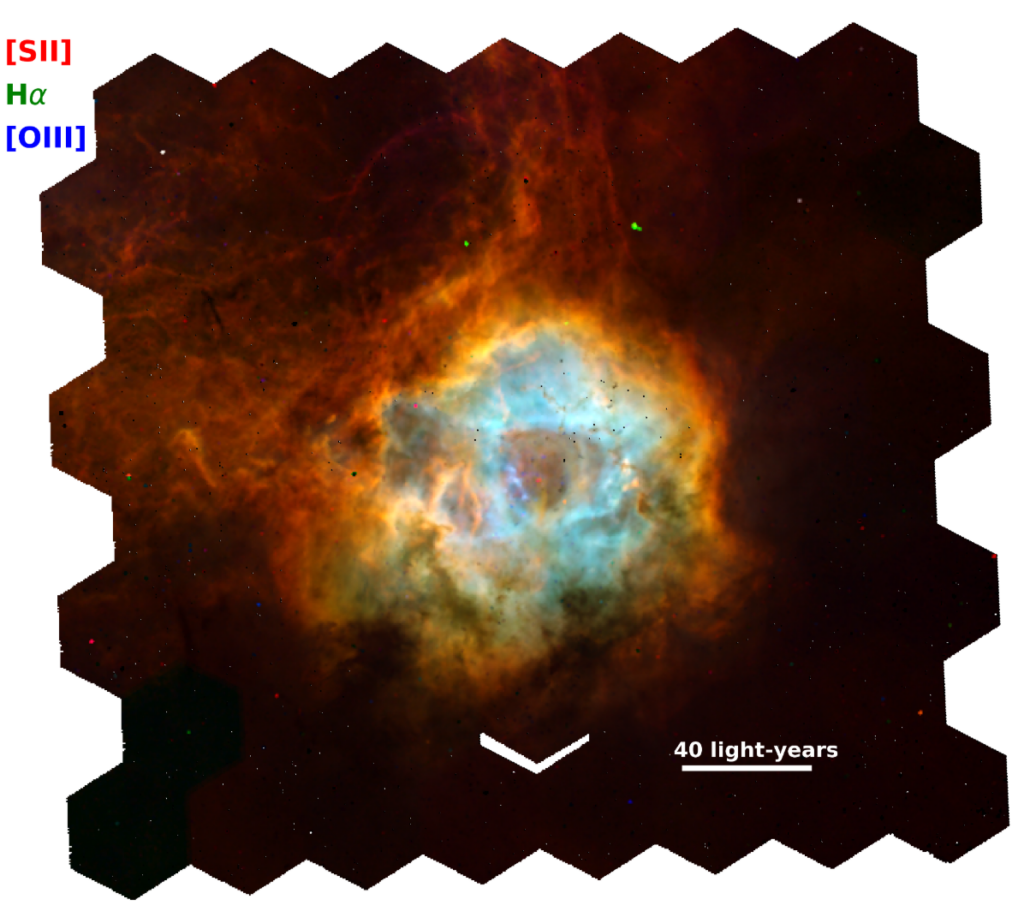
Image credit: SDSS-V Collaboration/M. Villa-Durango, UNAM
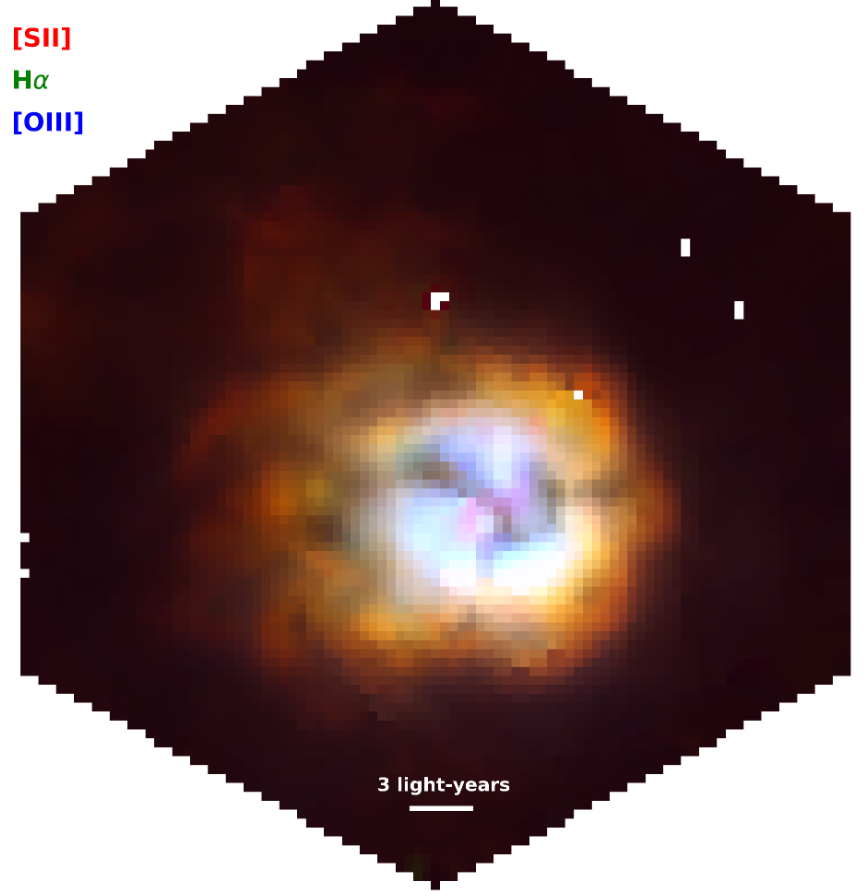
Image credit: SDSS-V Collaboration/M. Villa-Durango, UNAM
The SDSS-V data are vital for education and cutting-edge PhD research, which is one reason that Universities join the project. The power of this detailed spatial-spectral mapping is highlighted in recent studies focusing on well-known galactic nebulae, led by early-career researchers in the SDSS/LVM collaboration.
Driven by the radiation and energetic photons of a single massive star, the Triffid (latin for three-part) Nebula displays a surprisingly clean thermal structure reasonably well-described by theoretical models.
“In the Triffid Nebula, the density varies significantly as a result of the interaction between stellar radiation and the surrounding molecular gas,” observed Natascha Sattler, PhD student at Heidelberg University and lead author on the Triffid study. “Despite these pronounced density fluctuations, the temperature remains remarkably uniform across our two-dimensional view of the nebula. This simple thermal structure makes the Triffid Nebula an ideal laboratory for studying the chemical composition of star-forming regions.”
By contrast, the Rosette Nebula is driven by a massive, energetic cluster of young stars actively carving out surrounding molecular clouds into a complex, chaotic environment.
“Every region of the Rosette Nebula tells a different part of the story,” said Mónica Villa-Durango, PhD student at the Universidad Nacional Autónoma de México (UNAM) and lead author on the Rosette study. “By mapping its gas in detail, we can trace how the energy from massive stars reshapes the cloud and influences the evolution of the stellar clusters that are formed in the complex.”
Together, these studies highlight a key lesson: complex star-forming regions in distant galaxies are easily misunderstood when their internal physics cannot be directly resolved.
Open Science: Explore the Cosmos in Your Browser
To solve these cosmic puzzles, SDSS is making this initial set of LVM observations publicly available worldwide. The Data Release 20 (DR20) preview features 300,000 individual spectra covering 6 targeted regions—including the Triffid, Rosette, Orion, and Helix nebulae, alongside two nearby dwarf galaxies. While this represents just 1% of LVM’s planned 55+ million spectra, it marks a major step forward in open science. SDSS has released full code repositories alongside the data so researchers everywhere can make use of the observations freely.
To make this massive spatial-spectral dataset accessible to both professional astronomers and the public, the team developed LVMvis, a custom interactive web browser.
“I first developed LVMvis as a way to understand the LVM survey myself: what had been observed, what the data looked like, and how it was organized,” explained Dr. Ivan Katkov, researcher at NYU Abu Dhabi and project lead for LVMvis. “Now, LVMvis lets anyone explore the LVM data without needing to be an expert. You can see which parts of the sky have been observed, click on them, and immediately start looking at what the telescope has measured.”
Explore the interactive tool: LVMvis
“The cycle of stellar birth from and return to interstellar and intergalactic material is one of the most important research questions in modern astrophysics. As a theorist, I wanted a dataset that can help put our theoretical ideas to the test. The SDSS-V team has succeeded,” noted Dr. Juna Kollmeier, SDSS-V Director. “Many wrong theories will fall by the sword of LVM data. As it should be in science.”
Key Research Publications
- Triffid Nebula Study: Sattler et al. (2026), SDSS-V LVM: Resolving physical conditions in the Triffid Nebula, A&A, 706, A81. NASA ADS Abstract
- Rosette Nebula Study: Villa-Durango et al. (2025), SDSS-V Local Volume Mapper (LVM): revealing the structure of the Rosette Nebula, MNRAS, 543, 1196. NASA ADS Abstract
- Helix Nebula Data Release: Sánchez et al. (2026), SDSS-V Local Volume Mapper (LVM): Helix Nebula Public data, Data Analysis Pipeline data products, RMxAA, 62, 87. NASA ADS Abstract
About the SDSS
Funding for the Sloan Digital Sky Survey V has been provided by the Alfred P. Sloan Foundation, the Heising-Simons Foundation, the National Science Foundation, and the Participating Institutions. SDSS acknowledges support and resources from the Center for High-Performance Computing at the University of Utah. SDSS telescopes are located at Apache Point Observatory, funded by the Astrophysical Research Consortium and operated by New Mexico State University, and at Las Campanas Observatory, operated by the Carnegie Institution for Science. The SDSS web site is www.sdss.org.
SDSS is managed by the Astrophysical Research Consortium for the Participating Institutions of the SDSS Collaboration, including Caltech, the Carnegie Institution for Science, Chilean National Time Allocation Committee (CNTAC) ratified researchers, The Flatiron Institute, the Gotham Participation Group, Harvard University, Heidelberg University, The Johns Hopkins University, L’Ecole polytechnique fédérale de Lausanne (EPFL), Leibniz-Institut für Astrophysik Potsdam (AIP), Max-Planck-Institut für Astronomie (MPIA Heidelberg), Max-Planck-Institut für Extraterrestrische Physik (MPE), Nanjing University, National Astronomical Observatories of China (NAOC), New Mexico State University, The Ohio State University, Pennsylvania State University, Smithsonian Astrophysical Observatory, Space Telescope Science Institute (STScI), the Stellar Astrophysics Participation Group, Universidad Nacional Autónoma de México, University of Arizona, University of Colorado Boulder, University of Illinois at Urbana-Champaign, University of Toronto, University of Utah, University of Virginia, Yale University, and Yunnan University.