
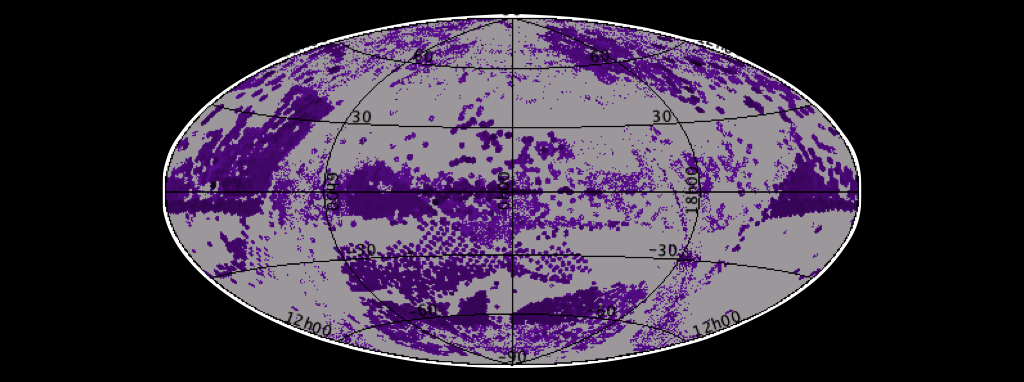
The Black Hole Mapper reaches a milestone with its first southern hemisphere optical observations, coordinated eROSITA X-ray identification, and multi-epoch tracking of accreting black holes across the universe.
APACHE POINT OBSERVATORY, NM & LAS CAMPANAS OBSERVATORY, CHILE — The Sloan Digital Sky Survey (SDSS) announces Data Release 20 (DR20), marking a landmark expansion in the study of accreting supermassive black holes (SMBHs). As part of the fifth generation of the survey (SDSS-V), the Black Hole Mapper (BHM) program is providing unprecedented insights into the masses, growth, and physics of quasars and active galactic nuclei (AGN) across cosmic time.
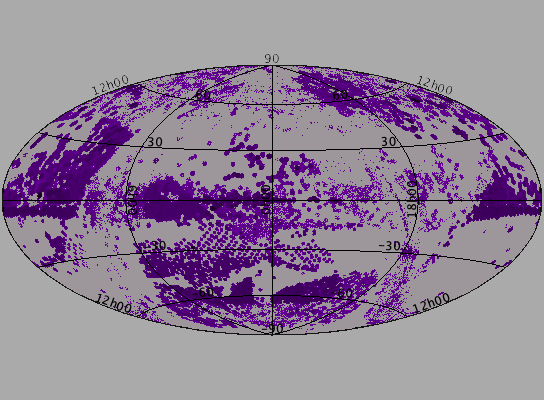
Image Credit: SDSS-V, Scott Anderson, University of Washington
DR20 delivers the first optical BOSS spectra from the southern hemisphere gathered at Las Campanas Observatory (LCO) in Chile, alongside expanded observations from Apache Point Observatory (APO) in New Mexico. In total, DR20 releases over 3.3 million optical spectra across 500,000 galaxies and 1.5 million stars, powering multi-wavelength discoveries in coordination with space-based observatories.
Unlocking the High-Energy Universe with eROSITA
Contacts
Scott Anderson
University of Washington
sfander@uw.edu
Andrea Merloni
Max-Planck-Institute for Extraterrestrial Physics
am@mpe.mpg.de
Mara Salvato
Max-Planck-Institute for Extraterrestrial Physics
mara@mpe.mpg.de
Yue Shen
University of Illinois
shenyue@illinois.edu
A core highlight of the Black Hole Mapper in DR20 is SPIDERS (SPectroscopic IDentification of ERosita Sources). By pairing SDSS optical spectroscopy with X-ray sky maps from the eROSITA mission, SPIDERS provides optical identifications and precise distance measurements (redshifts) for approximately 200,000 X-ray targets. This represents the largest, most uniform spectroscopic follow-up of X-ray sources ever assembled.
While SPIDERS captures tens of thousands of X-ray-emitting galaxy clusters and energetic star systems, the vast majority of these high-energy beacons are actively accreting supermassive black holes—known as active galactic nuclei (AGN) or quasars.
Mapping Cosmic Structure and Black Hole Demographics
X-ray emission acts as a beacon, allowing astronomers to peer directly into the central engines of these giant black holes and probe the hot X-ray coronae surrounding them. By measuring the “X-ray luminosity function”—essentially a census tracking how many black holes exist across different power outputs and cosmic eras—scientists can trace supermassive black hole growth from our cosmic neighborhood back to redshifts near six, pushing into the early Universe’s “cosmic dawn.”
Thanks to the combined wide-sky coverage of SDSS and eROSITA, this new dataset provides the tightest constraints to date on the rarest, most luminous quasars. The survey reveals more giant black holes early on and higher space densities of the most luminous AGN at high redshifts than previously expected. This reveals that rapidly growing giant black holes were surprisingly common in the early Universe. More “hidden” black holes have been uncovered,where traditional optical and UV sky surveys miss a substantial fraction of accreting black holes, particularly at lower luminosities and extreme distances. Also, by calculating total accumulated black hole growth over time, researchers found that soft X-ray-selected black holes account for only a minority of total black hole mass in the local Universe. This implies that 70% to 90% of all supermassive black hole growth occurred behind heavy veils of dust and gas, or during phases where even X-rays were suppressed.
“This release marks the culmination of more than a decade of joint planning and scientific exchange between the German eROSITA Consortium and the Sloan Digital Sky Survey”, said Dr. Andrea Merloni, eROSITA Principal Investigator and BHM Survey Scientist. “With DR20, we demonstrate not only that combining the X-ray and optical spectroscopic data opens up new and original scientific perspectives in astrophysics, but also that large, international and diverse collaborations can effectively work together for years towards a common goal.”
Probing the Inner Workings of Quasars Through Time
Because supermassive black holes themselves are too distant and compact to image directly, BHM leverages the hallmark variability of quasars across multiple time-domain sub-programs:
By capturing rapid, repeated spectra of targeted quasar fields over timescales ranging from days to years, the BHM Reverberation Mapping (RM) program measures time delays between light emitting from the central accretion disk and the surrounding broad-line region. This yields direct, geometric measurements of black hole masses across a wide range of redshifts.
Monitoring tens of thousands of quasars over repeated epochs, the SDSS-V All-Quasar Multi-Epoch Spectroscopy (AQMES) program tracks dynamical changes, accreting gas outflows, binary supermassive black hole candidates, and dramatic “changing-look” quasars transitioning states.
DSS-V has once again seen that Mother Nature is more wild than previously thought and this became clear as the spectra came in, some with such a huge variety that they broke the long-developed standard automated analysis pipelines. The team needed to visually inspect the spectra and that effort is being released as part of DR20.
“It has been fun to be part of the team that looked at these weirdos and learned how to deal with them! Something that will make the final SDSS-V/DR22 even greater,” said Dr. Mara Salvato, a senior scientist at the MPE and one of the eROSITA/SDSS-V collaboration coordinators.
“SDSS, also in coordination with other large-scale and multi-wavelength surveys such as eROSITA, continues as an intriguing, and widely-accessible, resource to learn further about active supermassive black holes — via the (sometimes surprisingly) prodigious and time-variable luminosity they power, extending across much of the electromagnetic spectrum”, reflected Dr. Scott Anderson, the BHM Program Head. “It’s inspiring to see the exciting research emerging, and that is often internationally led, including by early career researchers.”
Robotic Precision Across Both Hemispheres
This operational leap is made possible by SDSS-V’s Robotic Focal Plane System (FPS) installed on both the Sloan Foundation 2.5m Telescope at APO and the du Pont 2.5m Telescope at LCO. These automated positioning robots quickly configure optical fibers to feed into the high-throughput BOSS spectrographs, vastly accelerating multi-object observation rates and enabling dynamic Target of Opportunity (ToO) observing modes.
Open Data Access for the Global Scientific Community
In keeping with the quarter-century legacy of the Sloan Digital Sky Survey, all DR20 Black Hole Mapper data products are openly available to researchers, educators, and the public worldwide.
Through the Science Archive Server (SAS) & Catalog Archive Server (CAS) curious minds can access spectra, tabular data, and eROSITA counterpart catalogs via SciServer Compute and SQL queries. The SDSS Zora & Valis Web Interfaces allow users to interactively search target metadata, inspect spectral masks, and compare observed spectra with theoretical models directly in your browser or programmatically via Python. A series of value-added catalogs (VAC) and tutorials are also being made available as part of DR20 including dedicated AGN fitting VACs, visual inspection catalogs, and step-by-step Jupyter Notebook tutorials guiding users through multi-wavelength analysis.
Explore DR20 data and tools online at: www.sdss.org/dr20
“Quasars have long been known to vary and it is extremely exciting to be at the point where we can use those variations at scale, across multiple frequencies, to learn more about how black holes grow and evolve over cosmic time” said SDSS-V Director Juna Kollmeier. “The combination of optical and X-rays is extremely powerful, and we are proud to work with the eROSITA team on this cross-survey collaboration”
Key Research Publications
- Merloni, A., Lamer, G., Liu, T., et al. (2024). The SRG/eROSITA all-sky survey: First catalog of X-ray sources (eRASS1). Astronomy & Astrophysics, 682, A34.
ADS Abstract | Publisher Full Text - Ramos-Ceja, M. E., et al. (2026). The SRG/eROSITA All-Sky Survey: Second Data Release (eROSITA-DE DR2). Astronomy & Astrophysics (in press).
- Roster, W., Buchner, J., Salvato, M., et al. (2026). The eROSITA AGN X-ray Luminosity Function and Demographic Evolution. Astronomy & Astrophysics (submitted).
About the Sloan Digital Sky Survey V
Funding for the Sloan Digital Sky Survey V has been provided by the Alfred P. Sloan Foundation, the Heising-Simons Foundation, the National Science Foundation, and the Participating Institutions. SDSS acknowledges support and resources from the Center for High-Performance Computing at the University of Utah. SDSS telescopes are located at Apache Point Observatory, funded by the Astrophysical Research Consortium and operated by New Mexico State University, and at Las Campanas Observatory, operated by the Carnegie Institution for Science. The SDSS web site is www.sdss.org.
SDSS is managed by the Astrophysical Research Consortium for the Participating Institutions of the SDSS Collaboration, including Caltech, the Carnegie Institution for Science, Chilean National Time Allocation Committee (CNTAC) ratified researchers, The Flatiron Institute, the Gotham Participation Group, Harvard University, Heidelberg University, The Johns Hopkins University, L’Ecole polytechnique fédérale de Lausanne (EPFL), Leibniz-Institut für Astrophysik Potsdam (AIP), Max-Planck-Institut für Astronomie (MPIA Heidelberg), Max-Planck-Institut für Extraterrestrische Physik (MPE), Nanjing University, National Astronomical Observatories of China (NAOC), New Mexico State University, The Ohio State University, Pennsylvania State University, Smithsonian Astrophysical Observatory, Space Telescope Science Institute (STScI), the Stellar Astrophysics Participation Group, Universidad Nacional Autónoma de México, University of Arizona, University of Colorado Boulder, University of Illinois at Urbana-Champaign, University of Toronto, University of Utah, University of Virginia, Yale University, and Yunnan University.