
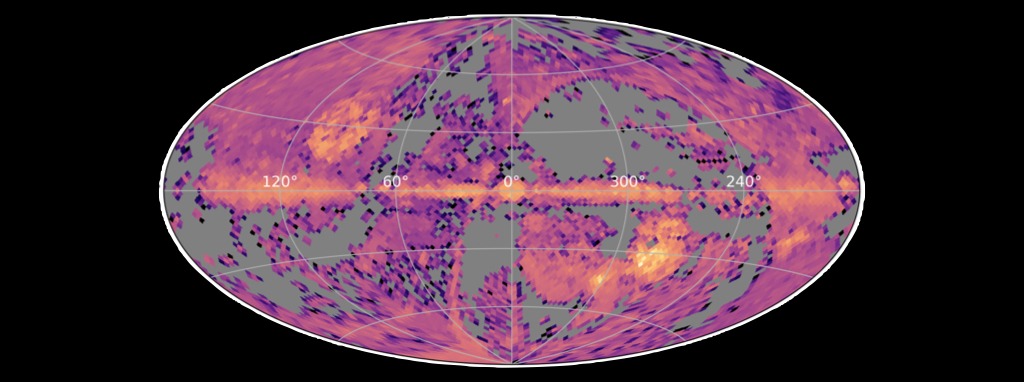
Data Release 20 (DR20) delivers more than two million spectra from twin observatories, revealing the chemical origins, stellar collisions, and ancient structure of the Milky Way
SUNSPOT, N.M. / LA SERENA, CHILE — The Sloan Digital Sky Survey V (SDSS-V) has announced its twentieth public data release (DR20), delivering a dramatic expansion of the Milky Way Mapper (MWM) scientific survey—the most detailed spectroscopic map yet assembled of stars in and around our home galaxy.
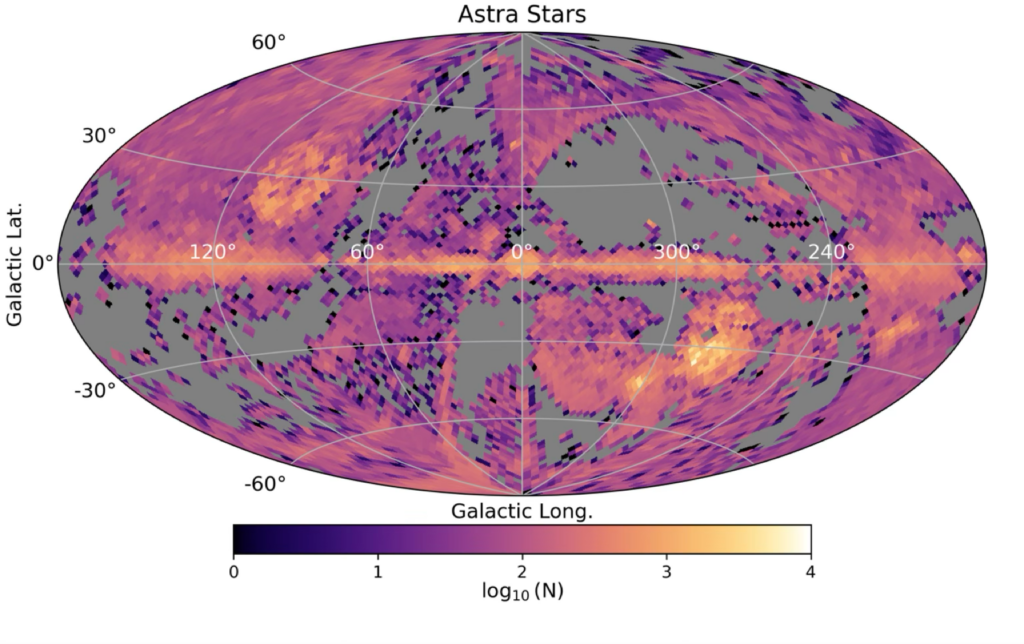
Image Credit: SDSS-V, Ilija Medan, University of Toronto
Contacts
Andrew Tkachenko
KU Leuven
andrew.tkachenko@kuleuven.be
J.J. Hermes
Boston University
jjhermes@bu.edu
Marina Kounkel
University of North Florida
marina.kounkel@unf.edu
Vedant Chandra
Harvard University
vedant.chandra@cfa.harvard.edu
With repeat visits, DR20 includes more than two million total spectra, revealing the temperatures, ages, and chemical compositions of stars all across the Milky Way. The dataset draws on observations from twin optical spectrographs at Apache Point Observatory in New Mexico and Las Campanas Observatory in Chile, giving astronomers a seamless view of stellar populations across both the northern and southern skies.
“It’s exciting to release such a massive catalog of high-quality spectra to the public,” said Dr. Marina Kounkel, assistant professor at University of North Florida and SDSS-V Survey Coordinator. She continued, “These data have already been extensively used by SDSS collaboration to enable a wide variety of scientific studies, but this is all just scratching the surface of what these data make possible.”
Uncovering Galactic Archeology in the Outer Halo
Among the release’s centerpiece results is the first major public dataset from the MWM Halo Program, which maps the faint, sparse stellar shroud enveloping the Milky Way’s disk. These ancient stars preserve a fossil record of the galaxy’s formation and its history of engulfing smaller satellite galaxies.
Across three complementary frontiers, the Halo program presents spectra of 250,000 halo stars including a full-sky survey of giant stars reaching more than 65,000 light-years away, fast-moving stars within 3,000 light-years of Earth, and pristine cosmic relics. This targeted hunt for ultra-metal-poor stars with iron levels less than 1% of the Sun, has already yielded the most pristine star in the Universe discovered by a class of undergrads at the University of Chicago. “We’ve had a wonderful time exploring this dataset,” said Deputy Project Scientist Alexander Ji of the University of Chicago. He continued “we can’t wait to see what everyone else will do with it.”
Mapping out the metal-poor outer halo of the Milky Way provides an important connection to the early Universe. Their chemical signatures and their orbital dynamics within the halo provide important clues for galaxy formation and evolution. A recent study led by Harvard graduate student Vedant Chandra is using SDSS-V data to map out these objects. “The Milky Way’s distant halo contains the fossil record of our Galaxy’s formation, but reading that record requires a truly all-sky view” said Vedant Chandra. “With SDSS-V, we can measure the motions, distances, and chemical compositions of halo stars across both hemispheres—allowing us to discover ancient stellar structures and map the dynamics of the Galaxy on an unprecedented scale. DR20 places this uniquely powerful dataset in the hands of the worldwide astronomical community.”
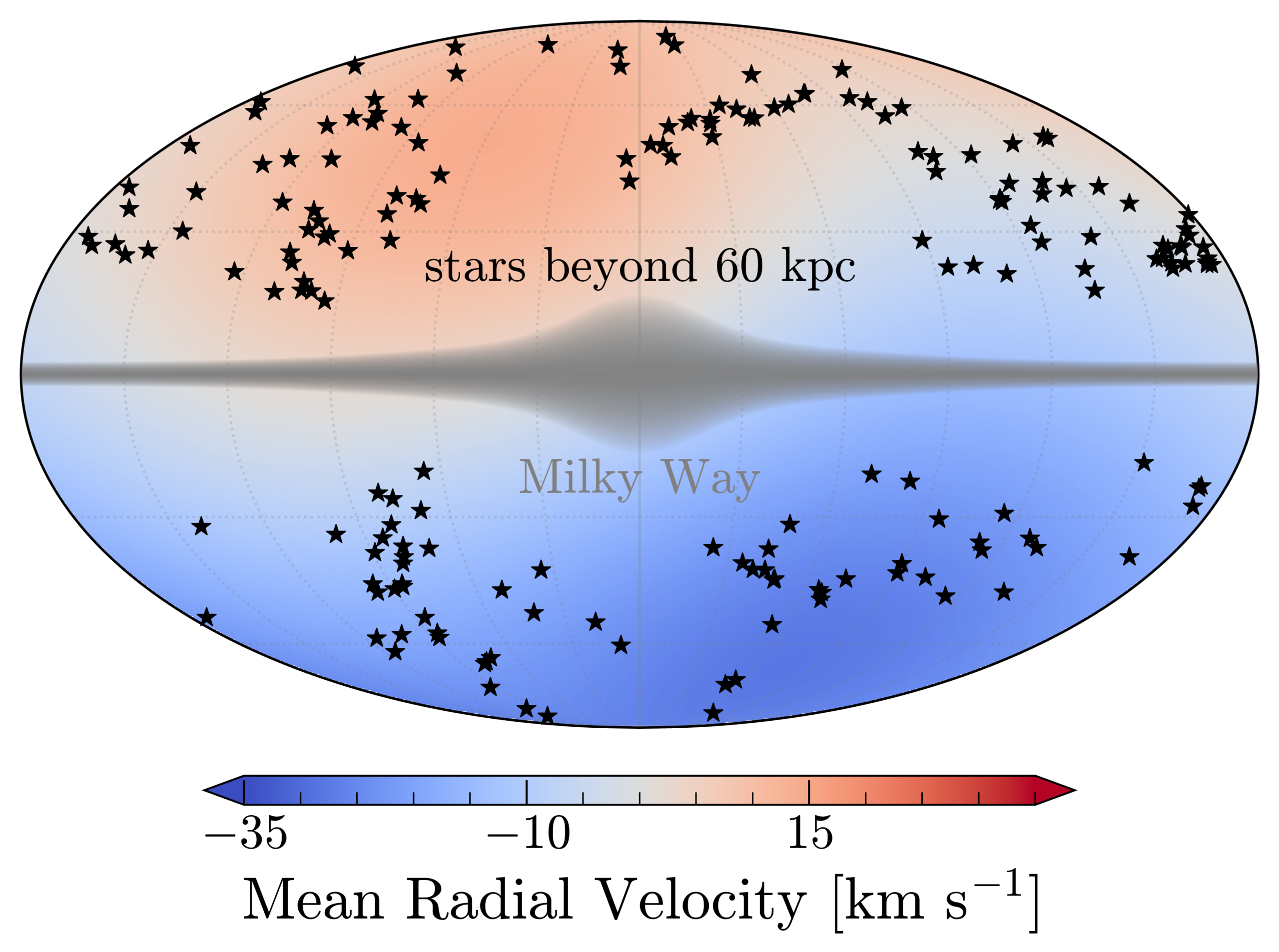
On-sky distribution of stars beyond 60 kiloparsecs observed by MWM in DR20. Stars belonging to known substructures like dwarf galaxies, globular clusters, and streams have been excised. The background shows the mean radial velocity of remaining ‘field’ stars relative to the center of the Milky Way, revealing a north-south asymmetry that only all-sky surveys can detect. This is a signature of the Milky Way’s dynamical response to its largest satellite galaxy (the Large Magellanic Cloud). Measuring it teaches us about the dark matter content of both galaxies. SDSS-V Collaboration/Vedant Chandra, Harvard University.
Image Credit: SDSS-V Collaboration/Vedant Chandra, Harvard University; Chandra et al. 2026 ApJ 1000 283
Doubling the Census of Stellar Remnants
Data Release 20 more than doubles the number of white dwarf stars available to the public from SDSS, adding 49,000 white dwarf spectra. White dwarfs are the dense, cooling remnants left behind when stars the size of our Sun exhaust their nuclear fuel. Over 80 percent of these white dwarfs had never been observed by SDSS before and over 40 percent lie in the southern sky—filling a critical observational gap in a region historically underserved by major spectroscopic surveys. These spectra preserve a direct record of how stars die, while their atmospheres frequently reveal telltale chemical signatures of shredded planetary bodies that once orbited them.
“This data release offers tens of thousands of new spectra of dead stars, many of which bear the signatures of remnant planetary systems that survived the evolution of their host star,” said Prof. JJ Hermes, a Milky Way Mapper Survey Scientist based at Boston University. “To collect this many spectra of white dwarfs, one by one, would have taken decades.”
A Complete Neighborhood Watch Within 300 Light-Years
Closer to home, the Solar Neighborhood Census is building the most complete spectroscopic map to date of objects within250 parsecs of the Sun. This study releases spectra for 280,000 nearby stellar neighbors, focusing on low-mass M dwarfs and brown dwarfs that make up three out of every four stars in our galaxy. By pairing SDSS-V spectroscopy with precise distances from the European Space Agency’s (ESA) Gaia satellite, astronomers now have a new benchmark dataset for understanding how stellar mass, age, and composition vary in our cosmic backyard.
Tracking Star and Planet Birth across the Galaxy
The expanded Young Galaxy Program quadrupled in scale from DR19 to DR20 and now encompasses over 200,000 young stars and planetary nurseries. Young stars still surrounded by planet-forming disks of gas and dust, displaying intense magnetic activity, are sun-like infants. The study also locates massive OB stars, whose recent formation outline the Milky Way’s spiral arms.
High-Energy Cosmic Cross-Matching with eROSITA
In an ongoing collaboration with ESA’s eROSITA X-ray space telescope, SDSS-V has gathered nearly 48,000 optical spectra of targets identified as energetic X-ray sources. This dataset matches high-energy space signals with their physical host stars—including accreting binary systems and magnetic stars—creating the largest joint optical/X-ray catalog assembled to date.
“Every stellar spectrum tells a story, and DR20 marks another step towards building a lasting spectroscopic legacy of our Galaxy,” said Dr. Andrew Tkachenko, from KU Leuven, Program Head for the Milky Way Mapper . “By making high-quality optical spectra of millions of stars publicly available, the SDSS-V Milky Way Mapper is enabling discoveries that will deepen our understanding of the Milky Way, the Magellanic Clouds, and the life cycles of stars.”
Ancient Relics in the Large Magellanic Cloud
Parallel to Data Release 20, a new study led by Lucey et al. (2026, ApJL, Vol. 1000, L44) utilizes SDSS-V data to announce the discovery of the first five carbon-enhanced metal-poor (CEMP) stars in the Large Magellanic Cloud (LMC). This extends the study of these ancient stellar fossils beyond the Milky Way for the first time, offering crucial clues about how the universe’s earliest supernovae seeded neighboring galaxies with chemical elements.
“Carbon-enhanced metal-poor stars give us a rare window into the oldest stars in the universe, ones that formed when the cosmos had far less heavy elements (like iron and oxygen) than it does today.” said Dr. Maddie Lucey. One of the biggest open questions about these stars is how much their nature depends on the galaxy they formed in. Do we expect the oldest stars in the Milky Way to be different from the oldest stars in a galaxy roughly a tenth its size, like the LMC? While tens of thousands of carbon-enhanced metal-poor stars have been discovered in the Milky Way, searches in the LMC, limited by smaller samples of stars, had previously come up empty, suggesting fundamental differences between the oldest stars in these two galaxies. Dr. Lucey continued, “the large SDSS-V sample enabled us to discover the first five carbon-enhanced metal-poor stars in the LMC, providing evidence that these differences may not be as extreme as previously thought.”
Key Research Publications
- Pristine star study: Ji et al. (2026) A nearly pristine star from the Large Magellanic Cloud, Nature Astronomy, Vol. 10, p. 842-857. NASA ADS abstract
- Halo star dynamics study: Chandra et al. (2026), Mapping the Distant and Metal-poor Milky Way with SDSS-V, ApJ 1000 283. NASA ADS abstract
- CEMP star study: Lucey et al. (2026), Discovery of the First Five Carbon-enhanced Metal-poor Stars in the LMC, ApJL, Vol. 1000, L44. NASA ADS abstract
About the Sloan Digital Sky Survey V
Funding for the Sloan Digital Sky Survey V has been provided by the Alfred P. Sloan Foundation, the Heising-Simons Foundation, the National Science Foundation, and the Participating Institutions. SDSS acknowledges support and resources from the Center for High-Performance Computing at the University of Utah. SDSS telescopes are located at Apache Point Observatory, funded by the Astrophysical Research Consortium and operated by New Mexico State University, and at Las Campanas Observatory, operated by the Carnegie Institution for Science. The SDSS web site is www.sdss.org.
SDSS is managed by the Astrophysical Research Consortium for the Participating Institutions of the SDSS Collaboration, including Caltech, the Carnegie Institution for Science, Chilean National Time Allocation Committee (CNTAC) ratified researchers, The Flatiron Institute, the Gotham Participation Group, Harvard University, Heidelberg University, The Johns Hopkins University, L’Ecole polytechnique fédérale de Lausanne (EPFL), Leibniz-Institut für Astrophysik Potsdam (AIP), Max-Planck-Institut für Astronomie (MPIA Heidelberg), Max-Planck-Institut für Extraterrestrische Physik (MPE), Nanjing University, National Astronomical Observatories of China (NAOC), New Mexico State University, The Ohio State University, Pennsylvania State University, Smithsonian Astrophysical Observatory, Space Telescope Science Institute (STScI), the Stellar Astrophysics Participation Group, Universidad Nacional Autónoma de México, University of Arizona, University of Colorado Boulder, University of Illinois at Urbana-Champaign, University of Toronto, University of Utah, University of Virginia, Yale University, and Yunnan University.