
University of Virginia Art Professor William Wylie and Professor of Astronomy Nitya Kallivayalil transform Sloan Digital Sky Survey data into a striking visual experience at the Contemplative Sciences Center.
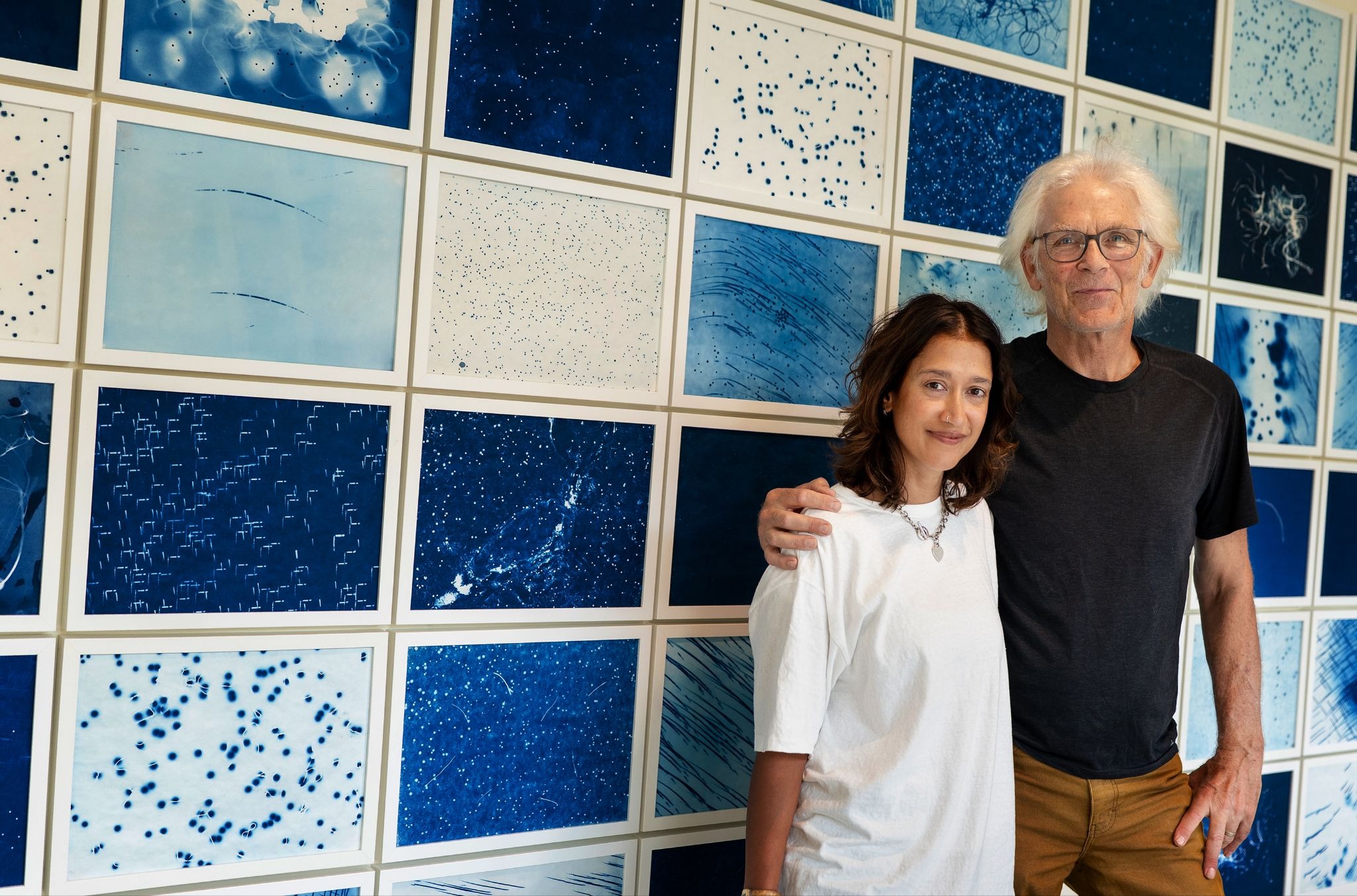
Photo credit: Evan Kutsko
Contacts
Emily Griffith
Scientific Spokesperson, SDSS-V
University of Colorado Boulder
Emily.Griffith-1@colorado.edu
Bill Wylie
Professor of Art
University of Virginia
ww9b@virginia.edu
Nitya Kallivayalil
Professor of Astronomy
University of Virginia
njk3r@virginia.edu
“Firmament,” a groundbreaking collaborative exhibition bridging contemporary art and astrophysics, is currently on view at the Contemplative Sciences Center at the University of Virginia. By transforming astronomical artifacts into vivid physical prints, the installation offers a compelling intersection of scientific discovery and artistic expression.
The inspiration for “Firmament” originated during a dinner conversation between friends Commonwealth Professor William Wylie and UVA Astronomer Nitya Kallivayalil. Wylie noticed an aluminum star plate from the Sloan Digital Sky Survey (SDSS)—specifically from the APOGEE project, provided by astronomer John Wilson—hanging on the wall. These round aluminum plates feature precision-drilled holes mapping exact stellar locations observed by the telescope, where optical fibers were manually plugged to collect light from celestial objects.
Recognizing the aesthetic and conceptual potential of these astronomical artifacts, Wylie and Kallivayalil partnered to create cyanotype prints directly from the plates. Invented in 1842 by the famous astronomer Sir John Herschel, cyanotype is a 19th-century photographic process using light-sensitive chemistry on paper. Cyanotypes use ultraviolet light from the sun to expose the prints. Using our star to generate images of stars creates a profound conceptual bridge linking the medium directly to astronomy.
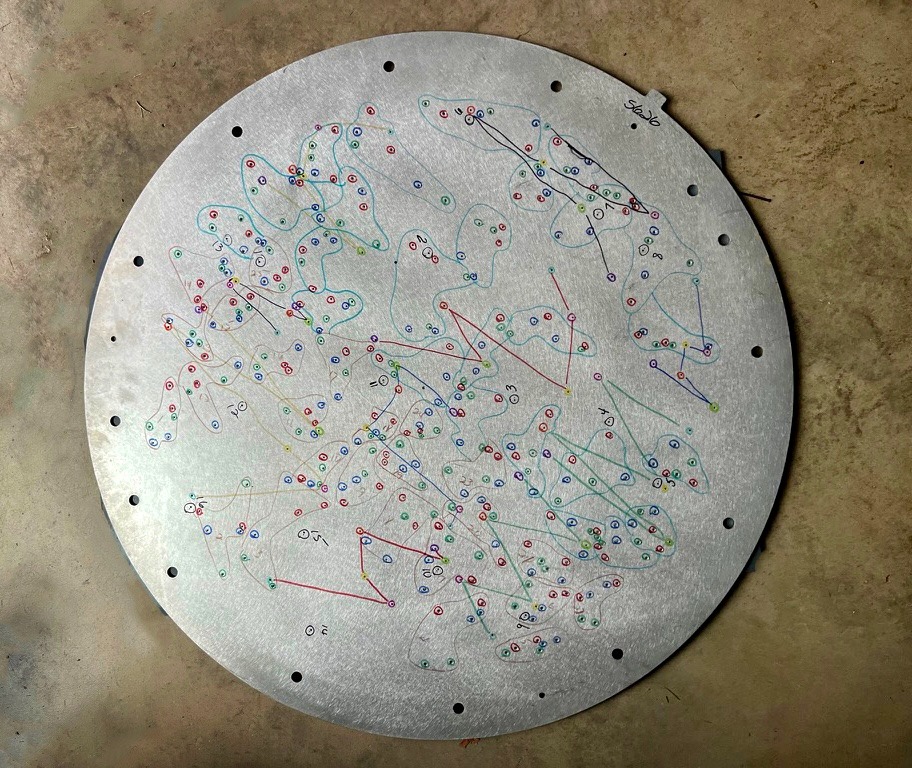
Photo credit: Bill Wylie
To produce the prints, light-sensitive liquid was applied to delicate Japanese Sumi paper. Placed under the star plates and exposed to direct sunlight, pinholes in the aluminum allowed sunlight to pass through, creating intricate star patterns in blue. Those prints could then be used as negatives by placing them in contact with freshly sensitive paper and exposing to the sun to produce white stars on deep Prussian backgrounds. Several prints were created by separating the plate and paper at various distances, allowing the movement of the sun over the course of a day to produce a ‘track’. Exposure times ranged anywhere from 30 minutes to 12 hours depending on ambient light, weather, season, and natural chance.
Through extensive experimentation with multiple plates and layered exposures, the duo generated over 300 12×15” cyanotypes, culminating in a selection of 114 mounted prints curated and arranged by Wylie for the final exhibition wall. The grid offers viewers a multi-scalar perspective: visitors can inspect individual cosmic frames up close or step back to admire the sweeping collective galaxy of stars.
Professor Kallivayalil is an astronomer who specializes in near-field cosmology and galactic structure. She is thrilled with “Firmament”, which is a true collaboration between art and science.
“The exhibition is absolutely beautiful and it has been so interesting to see it evolve,” said Prof. Kallivayalil, “The Sloan Digital Sky Survey was created to provide access to astronomical data and Bill has rendered that goal in an approachable way. This work is a manifestation of the Survey.”
Response to the show has been very enthusiastic and people are deeply engaged with the images. Astronomers who attend the show have been asking the most questions and can sometimes identify the objects pictured in a single frame. The success of the show is in bringing the sometimes abstract science of astronomy into a very accessible form of art.
Dr. Juna Kollmeier, Director of the Sloan Digital Sky Survey, expressed her excitement for the collaboration.
“This is a beautiful exhibit and a marvelous concept. In ‘Firmament’, Profs. Kalivayalil and Wylie have honored the heavens and honored the SDSS whose mission continues to ‘turn many to righteousness’ by providing the data from the survey, and now its relics, to all,” said Dr. Kollmeier.
The exhibition will remain on view indefinitely at the Contemplative Sciences Center at the University of Virginia.
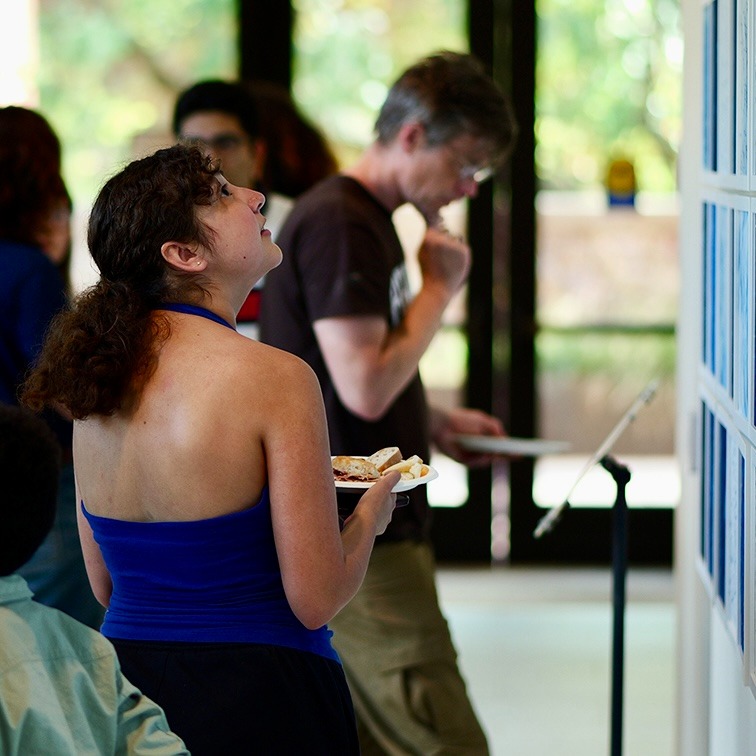
Photo credit: Evan Kutsko
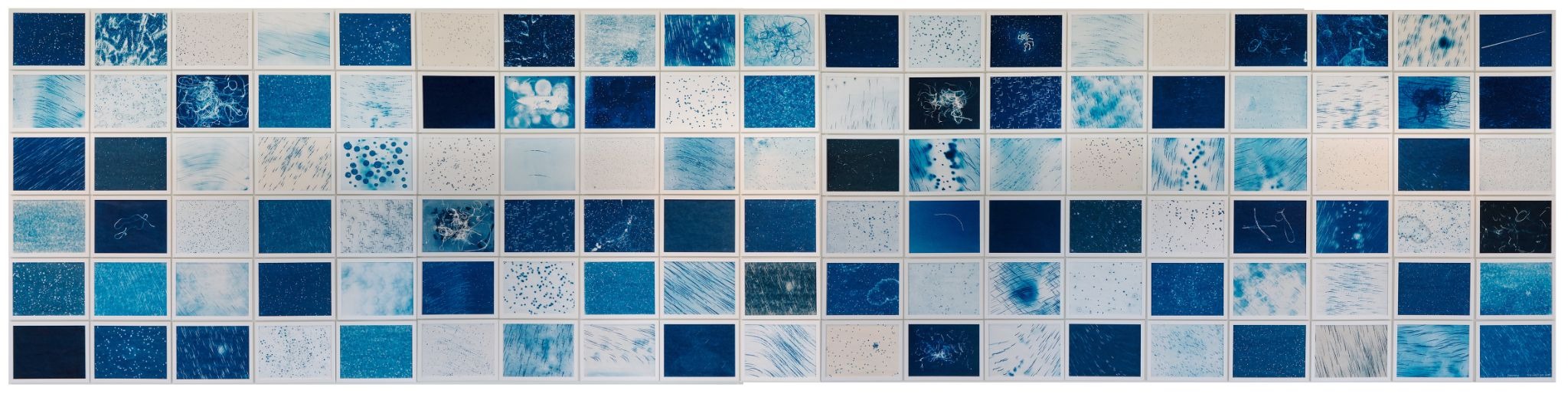
Photo credit: Bill Wylie