
Summary
The corv (Compact Object Radial Velocity) pipeline (Chandra et al. 2023; Crumpler et al. 2024) measures the radial velocity, effective temperature, and surface gravity for DA-type white dwarfs observed with the BOSS spectrograph.
Detailed Description
corv linearly interpolates between the Montreal models of DA–type white dwarfs to forward model white dwarf spectra. The spectra are continuum-normalized locally around individual absorption lines (e.g., the Balmer series), which are compared against the data. The effective temperature, surface gravity, and radial velocity are first fit simultaneously by minimizing the χ2 statistic with the Levenberg-Marquardt optimization algorithm. The radial velocity is then refined using a brute force χ2 minimization of the template on a fine grid to produce a more accurate measurement.
The pipeline reports the best-fit parameters and the corresponding (formal) uncertainty estimates of those parameters, and other relevant summary statistics (e.g., χ2 value, initial values, and flags).
Data Products
corv expects BOSS spectra in the observed frame. For this reason, Astra provides specFull files to corv, but only for white dwarfs that are confidently classified by Snow White as DA-type (e.g., classification is “DA”). corv is not executed on the BOSS coadded spectra stored in mwmStar files, as those have already been shifted to rest wavelength.
corv produces a summary file of results, and pipeline spectrum-level products. The summary file astraAlllVisitCORV stores the results from the corv pipeline on individual BOSS visit spectra. For each sdss_id, corv also produces a corresponding astraVisitCORV file which stores the same pipeline outputs as the astraAllVisitCORV file, but also includes the best-fit model spectrum and best-fit continuum.
Crumpler et al. (2025) have constructed a Value-Added catalog for DA white dwarfs from SDSS-V for DR19.
Validation and Uncertainties
Figure 1 shows a comparison between corv radial velocities (RVs) and those from the high-resolution SPY survey (Napiwotzki et al. 2020). This is an expanded sample compared to DR19, with 127 DA WDs in common. The mean absolute error is 17 km/s, with a bias of 5 km/s.
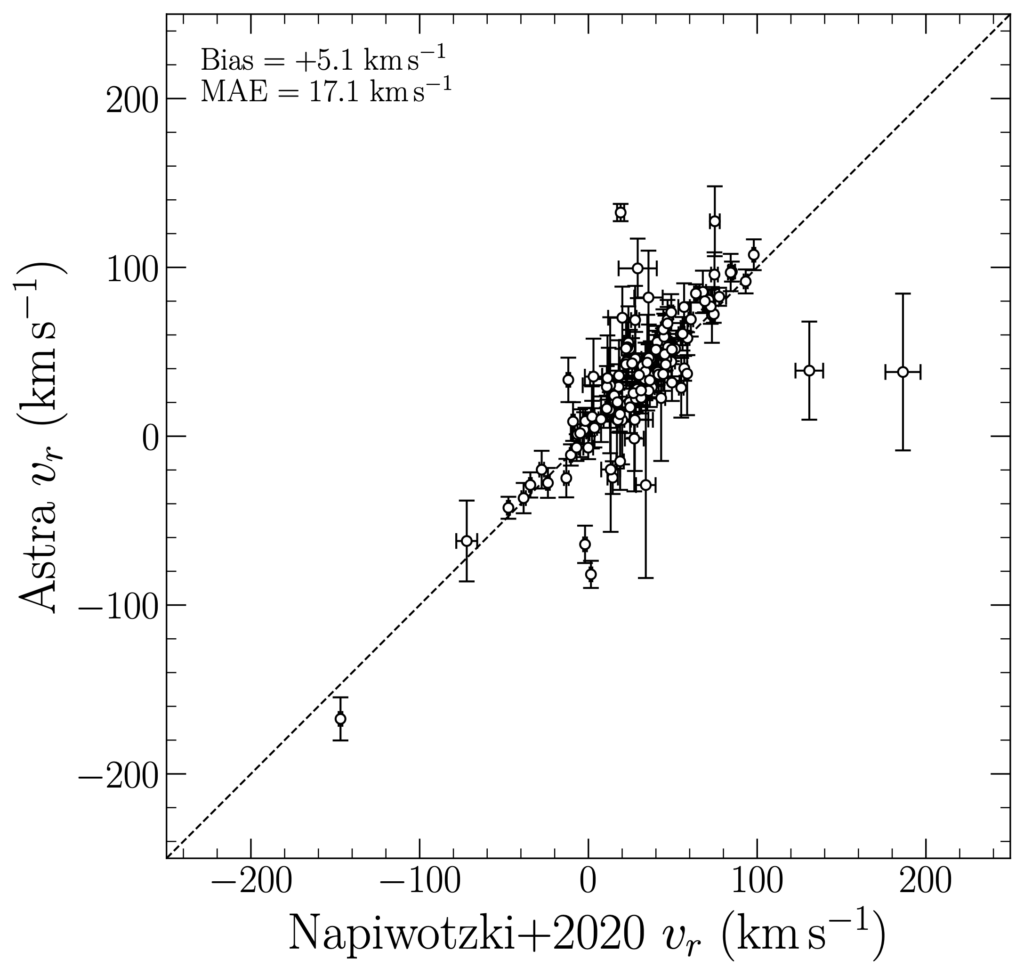
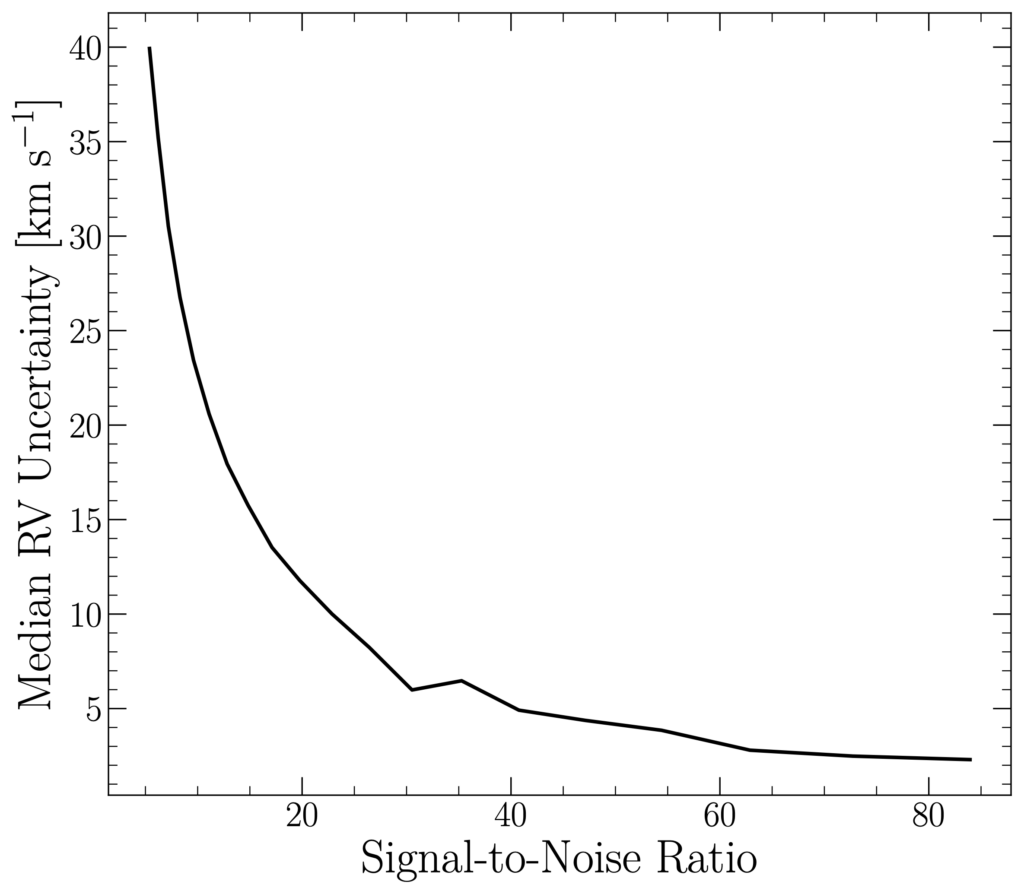
corv (aka Astra) RVs vs. SPY (Napiwotzki et al) RVs for DA white dwarfs (figure by Stefan Arseneau)The RV accuracy depends strongly on the SNR (Figure 2). These results are consistent with previous results for DR19. Crumpler et al. (2024) compared the RVs (Doppler + gravitational redshift) measured by corv to published SDSS WD catalog radial velocities and found agreement to better than 9 km/s for spectra with signal-to-noise ratio ≥20. Arseneau et al. (2024) compared the RVs from Chandra et al. (2020), also measured with corv, to literature values based on high-resolution spectra. They found a mean absolute error of 14.2 km/s and a bias of 0.2 km/s.
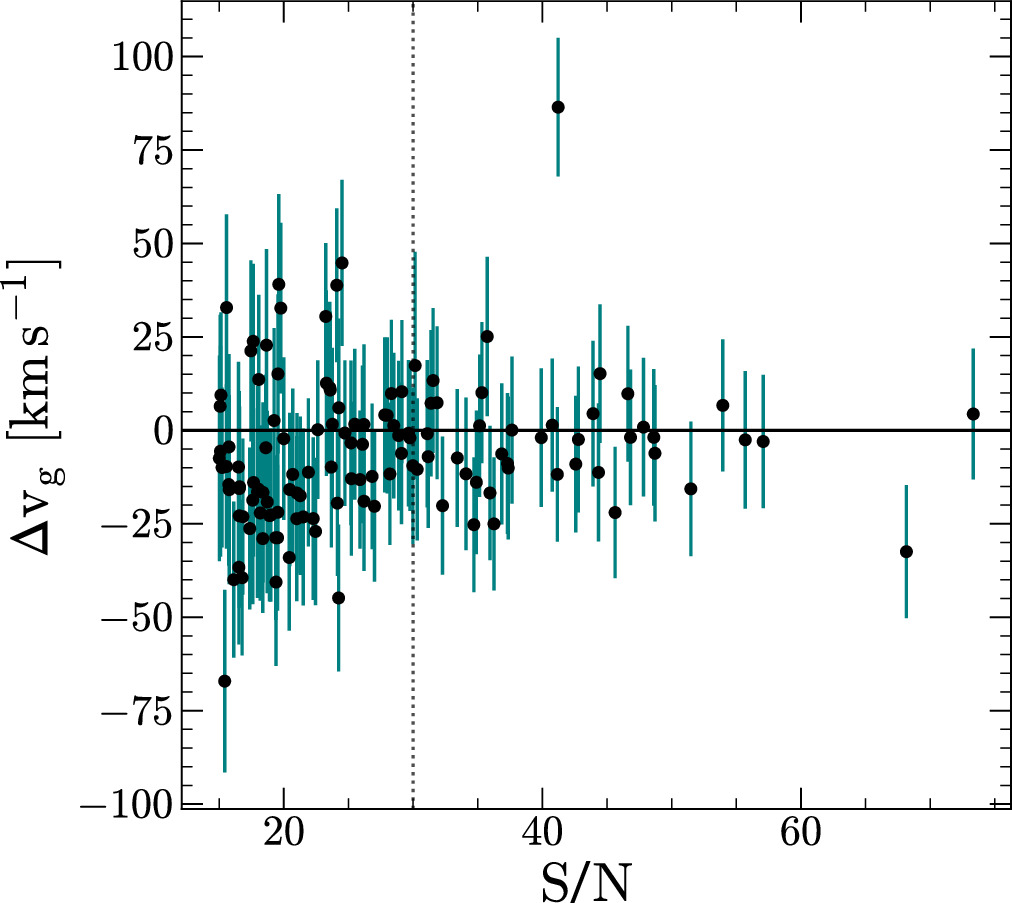
Arseneau et al. (2024) tested the zero point of corv RVs by obtaining the expected radial velocities of white dwarfs in wide binary systems using the RV of the main-sequence companion. Subtracting that from the observed RV of the WD, they isolated the gravitational redshift. They used Gaia data to calculate the surface temperatures and radii of these white dwarfs and found their gravitational redshifts. Figure 2 shows the difference between the expected and measured CORV gravitation redshift as a function of SNR. Overall, the agreement in zero point is excellent and improves with higher SNR data.
Flags
The corv pipeline outputs in DR20 only include bitmask flags describing why the pipeline was not run on a source (see below table). Otherwise, for all sources that corv was run on result_flags will always be zero. The user should then exercise judgement about what quality criteria are suitable for their scientific goals.
| Field Name | Bit | Flag Name | Flag Description |
result_flags | 5 | NOT_MWM_WD | Object not in the mwm_wd program |
result_flags | 6 | NO_WD_CLASSIFICATION | No SnowWhite classification available |
result_flags | 7 | NOT_DA_TYPE | Object is not classifies as DA-type by SnowWhite |