
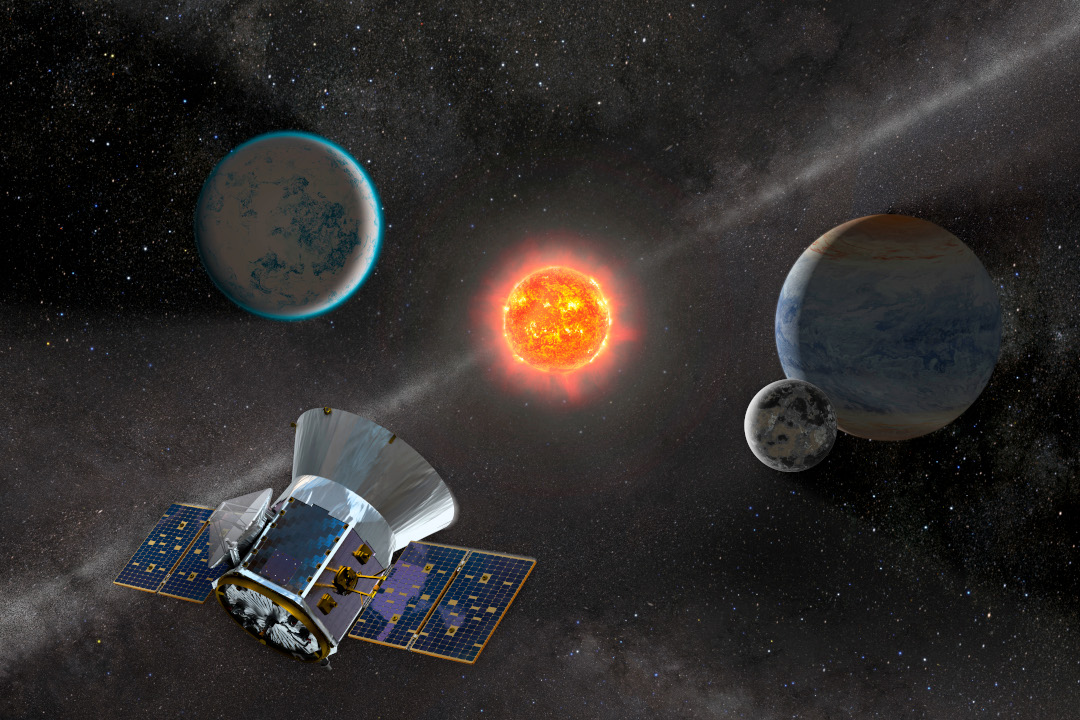
The goal of the Planet Host program is to create a uniform catalog of stellar characteristics and elemental abundances derived from APOGEE spectra of planet hosting stars. The program was originally conceived as a follow-up program for the Transiting Exoplanet Survey Satellite (TESS) mission, targeting all stars from the TESS mission with light curves taken with the 2-minute cadence during the nominal 2-year mission, with priority given to those 2-min cadence stars that host TESS Objects of Interest (TOIs) or Community TOIs (CTOIs) are given higher priority. This dataset would thus allow robust comparisons of stellar characteristics between stars with and without TOIs.
The Planet Host program was later expanded to include all known planet hosts (excluding those discovered with microlensing or pulsar timing techniques) not already observed with the APOGEE instrument. Altogether, the program will produce for the first time in the exoplanet subfield a large, homogeneous sample of fundamental and photospheric stellar parameters and individual elemental abundances. The selection criteria of the expanded sample will be available in a future data release.
Cartons
manual_mwm_planet_ca_legacy_apogee
These targets are from Rosenthal et al. (2021), 719 solar neighborhood stars uniformly searched with the Doppler technique for giant planets, brown dwarfs, and low-mass stars as part of the California Legacy Survey. At least 20 High Resolution Echelle Spectrometer (HIRES) precision radial velocity measurements over an eight-year time baseline were required for inclusion in this sample.
manual_mwm_planet_gaia_astrometry_apogee
These targets are from the Gaia EDR3 100 pc sample, 35,383 solar neighborhood stars with distances and masses that will permit three-sigma astrometric detections of planet-mass objects with orbital periods in the range 1 yr < P < 10 yr assuming the projected astrometric precision of Gaia DR5.
manual_mwm_planet_gpi_apogee
Targets from the Gemini Planet Imager (GPI) Campaign Target List, a sample of 625 stars that were uniformly searched with the direct imaging technique for planet-mass objects as part of the GPI Extra Solar Survey (GPIES).
manual_mwm_planet_harps_apogee
Targets from Trifonov et al. (2020), 684 solar neighborhood stars with at least 20 High Accuracy Radial velocity Planet Searcher (HARPS) spectrograph precision radial velocity measurements over an eight-year time baseline.
manual_mwm_planet_known_apogee
Targets from the NASA Exoplanet Archive, as of January 2, 2023 all 1,807 known exoplanet host stars after removing microlensing and pulsar timing discoveries as well as Kepler discoveries intensively studied as part of SDSS-III and SDSS-IV. This carton was updated with 2,001 targets to include know exoplanets through May 23, 2024. The original version of this carton was observed from Targeting Generation v1.0.2 through v1.0.4. The updated version was observed in Targeting Generation v1.0.5.
manual_mwm_planet_sophie_apogee
Targets from the SOPHIE archive, as of January 2, 2023 all 425 solar neighborhood stars with at least 20 Spectrographe pour l’Observation des Phénomènes des Intérieurs stellaires et des Exoplanètes (SOPHIE) precision radial velocity measurements over eight years.
manual_mwm_planet_sphere_apogee
rom the Spectro-Polarimetric High-contrast Exoplanet REsearch (SPHERE) Guaranteed Time Observing (GTO) program and/or Large Program protected targets lists for European Southern Observatory (ESO) Periods 95, 96, 97, 98, 99, 100, 101, 102, 103, 104, and 105, a sample of 855 stars that were searched with the direct imaging technique for planet-mass objects.
manual_mwm_planet_tess_eb_apogee
Targets from the Transiting Exoplanet Survey Satellite (TESS) eclipsing binary catalog presented in Prša et al. (2022), 4,566 candidate eclipsing binaries.
manual_mwm_planet_tess_pc_apogee
Targets from the NASA Exoplanet Archive-hosted TESS Object of Interest (TOI) list, as of January 2, 2023 all 4,532 TOIs with tfopwg_disp one of ”, “APC”, “PC”, or “CP” (i.e., undispositioned, ambiguous planet candidate, planet candidate, and confirmed planet). This carton was updated to include 5,253 TOIs going through May 23, 2024. The original version of this carton was observed from Targeting Generation v1.0.2 through v1.0.4. The updated version was observed in Targeting Generation v1.0.5.
manual_mwm_planet_transiting_bd_apogee
Targets from the catalog maintained by Kevin Schlaufman, a sample of 56 transiting brown dwarf systems with spectroscopic orbits.
mwm_tess_planet
Targets are drawn from a catalog of 2-min, TOI, and CTOI targets. Thus, the selected stars have a profile similar to those in the TESS Input Catalog (TIC, Stassun et al. 2019). The 2-min targets came from sectors 1 through 32 which were downloaded from https://tess.mit.edu/observations/target-lists/ on 11/24/2020. The TOI targets come from two sources. The first source was the MIT website (https://tess.mit.edu/toi-releases/) and included data from sectors 1 through 29. It was also downloaded on 11/24/2020. The second source was the Exoplanet Follow-up Observing Program (ExoFOP) website (https://exofop.ipac.caltech.edu/tess/index.php), which was also downloaded on 11/24/2020 and included sectors 1 through 21. The CTOI candidates also come from the ExoFOP website.
With the addition of 2MASS H-band magnitudes, the full selection criteria are:
- Candidate in 2-min, TOI, CTOI catalogs described above
- 7 < H < 12
mwm_tess_2min_apogee
This carton is an update of mwm_tess_planet using an updated catalog derived from the MIT and Exoplanet Follow-up websites. The 2-min targets came from sectors 1 through 54 which were downloaded from https://tess.mit.edu/observations/target-lists/ on 08/01/2022. The TOI targets come from two sources. The first source was the MIT website (https://tess.mit.edu/toi-releases/) and included data from sectors 1 through 54. It was also downloaded on 08/01/2022. The second source was the Exoplanet Follow-up Observing Program (ExoFOP) website (https://exofop.ipac.caltech.edu/tess/index.php), which was also downloaded on 08/05/2022 and included sectors 1 through 54.
mwm_planet_tess
This is the plate-era name of the mwm_tess_planet carton. Both cartons share the same program name, mwm_planet. Like the mwm_tess_planet carton, targets are drawn from a catalog of 2-min, TOI, and CTOI targets. Thus, the selected stars have a profile similar to those in the TESS Input Catalog (TIC, Stassun et al. 2019). The 2-min targets came from sectors 1 through 23 which were downloaded from https://tess.mit.edu/observations/target-lists/ on 04/02/2020. The TOI targets come from two sources. The first source was the MIT website (https://tess.mit.edu/toi-releases/) and included data from sectors 1 through 21. It was also downloaded on 04/02/2020. The second source was the Exoplanet Follow-up Observing Program (ExoFOP) website (https://exofop.ipac.caltech.edu/tess/index.php), which was also downloaded on 04/02/2020 and included sectors 1 through 21. The CTOI candidates also come from the ExoFOP website.
Cadences
During plate operations, these targets could be observed on any plate except those with the RM cadence.
In the FPS era, targets are assigned a cadence based on their H magnitude to achieve a signal-to-noise of at least 80.
![\[ N = \frac{60 min}{15 min} \times (80^2 / 100^2) \times 10^{(0.4 \times (Hmag-11)} \]](https://quicklatex.com/cache3/cb/ql_927fd0636966ad2ead230e0e588226cb_l3.png "Rendered by QuickLaTeX.com")
Number of exposures =  rounded to the nearest integer.
Between 1 and 6 exposures is needed per epoch to achieve the requisite S/N, so the full list of cadences is:
- bright_1x1
- bright_flexible_1x2
- bright_flexible_1x3
- bright_flexible_1x4
- bright_flexible_1x5
- bright_flexible_1x6