
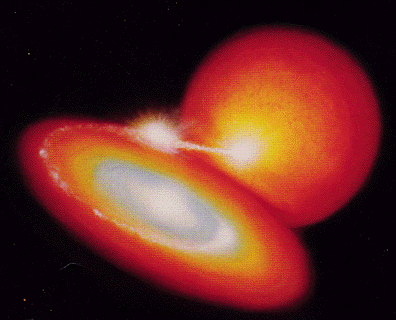
Image Credit, Dana Berry, STScI
The compact binaries program encompasses a number of scientific cartons, each with its own target selection strategy, organized around the common goal of multi-epoch spectroscopic characterization of known or suspected compact binary systems. Both the BOSS and APOGEE spectrographs are used by this program, depending on the system brightness. Generally, the target selection relies on the expectation that compact binary systems will show an excess in ultraviolet flux contributed by the (optically) unseen compact companion or shows distinctive variability. White dwarf binaries can be selected by a simple linear cut in a UV-optical color magnitude diagram, which is used for both the “gaiagalex” and volume limited “300pc” cartons. Candidate cataclysmic variables were identified from the AAVSO Variable Star Index. Various flavors of “UV-excess” color/magnitude cuts with different UV passbands result in the uvex1 – uvex5 cartons. The uvex1 – uvex4 cartons use the BOSS spectrograph, while uvex5 uses APOGEE.
Cartons
mwm_cb_300pc
This is the plate era carton targeting white dwarf binaries within 300 pc with a simple linear cut in the GALEX FUV and NUV color magnitude diagram. Distances ( rest) come from Bailer-Jones et al. (2018). The selection criteria are:
- (FUV – 5 * log10(rest/10)) > 14 * (FUV-NUV) – 46
- rest < 300pc
In the FPS-era, the carton was split into two different cartons that share the same basic selection, but mwm_cb_300pc_apogee limits the H-band magnitude from the 2MASS Point Source Catalog to H < 11 while mwm_cb_300pc_boss requires that the target is detected in Gaia DR2.
Note that an error in the targeting code led to targets being selected in version 0.5.0 with the wrong inequality in the UV color magnitude cut. See Targeting Flags for more information on targeting versions.
All three variations of the carton can be identified with the mwm_cb_300pc alternate carton name.
mwm_cb_cvcandidates
This is the plate era carton of AAVSO cataclysmic variable targets. The “AAVSO catalog” (mos_cataclysmic_variables) was constructed from the VSX catalog, selecting cataclysmic (explosive and novalike) variables (N, NA, NB, NC, NL, NR, SN, SNI, SNII, UG, UGSS, UGSU, UGZ, ZAND) downloaded in summer 2019 and then manually pruned. The mos_catalclysmic_variables catalog can be queried on CasJobs or downloaded from the SAS.
In the FPS-era, the carton was split into two different cartons that share the same basic selection, but mwm_cb_cvcandidates_apogee limits the H-band magnitude from the 2MASS Point Source Catalog to H < 11 while mwm_cb_cvcandidates_boss requires that the target is detected in Gaia DR2. There was no change to the _apogee and _boss carton in targeting v1 they continue to use Gaia DR2.
All three variations of the carton can be identified with the mwm_cb_cvcandidates alternate carton name.
mwm_cb_gaiagalex
This plate era carton combines Gaia DR2 mean photometric G magnitudes with GALEX FUV. White dwarf binaries separate well from the main sequence in absolute FUV vs FUV-G color. Gaia also provides parallax (p) and parallax error (perr). The selection criteria are:
- p / perr > 3
- G < 20
- FUV + 5 * log10(p / 1000) + 5 > 1.5 + 1.28 * (FUV – G)
In the FPS-era, the carton was split into two different cartons that share the same basic selection, but mwm_cb_gaiagalex_apogee limits the H-band magnitude from the 2MASS Point Source Catalog to H < 11 while mwm_cb_gaiagalex_boss requires that the target is detected in Gaia DR2.
All three variations also belong to the mwm_cb_galex alternate carton name, together with some of the UV excess cartons below.
This v1 carton uses Gaia DR3 and Nicola Gentile Fusillo’s Gaia/GALEX cross-match to select objects that lie below the main-sequence in an FUV/optical absolute magnitude-color diagram. The carton then removes AGN interlopers. Finally it removes the LMC and SMC, where a lot of hot young stars mimic the properties of this target selection.
- All quantities are Gaia DR3
- pm = sqrt(pmra*pmra+pmdec*pmdec)
- pm_error = sqrt((pmra_error*pmra/pm)*(pmra_error*pmra/pm)+(pmdec_error*pmdec/pm)*(pmdec_error*pmdec/pm))
- logpmdpm = log10(pm/pm_error)
- poe = parallax / parallax_error
- fuv_mag + 5*log10(parallax/1000) + 5 > 1.5 + 1.28*(fuv_mag – phot_g_mean_mag)
- fuv_mag + 5*log10(parallax/1000) + 5 > 2.5*(fuv_mag – phot_g_mean_mag) – 0.5
- fuv_magerr < 0.3
- NOT (logpmdpm < 0.301 AND poe > -1.75*logpmdpm – 2.8 AND poe < 1.75*logpmdpm + 2.8 OR (logpmdpm-0.301)*(logpmdpm-0.301) / (0.33*0.33) + (poe * poe) / (3.2* 3.2)<=1)
- NOT ((sqrt( pow(l-280.3,2) + 2*pow(b+33.0,2) ) < 8) OR sqrt(0.5*square(l-301) + 2*square(b+43.3) ) < 5)
mwm_cb_galex_vol_boss
This v1 carton uses Gaia DR3 and Nicola Gentile Fusillo’s Gaia/GALEX cross-match to select objects that lie below the main-sequence in an NUV/optical absolute magnitude-color diagram. Remove known AGN & galaxies from published catalogues. Remove AGN interlopers by parallax / proper motion. Remove the LMC and SMC, where a lot of hot young stars mimic the properties of this target selection. Makes use of milliquas (million quasar catalog https://quasars.org/milliquas.htm) and HECATE (Heraklion Extragalactic Catalog – https://hecate.ia.forth.gr) to remove contaminants.
- Select entries with maximum separation between Gaia and GALEX position of 2.5 arcsec.
- Retrieve Gaia distances from Bailer-Jones et al. (2022) (referred to as either r_med_geo or r_geo)
- Eliminate known AGN, i.e. all milliquas entries with 100% probability being an AGN within a radius of 1 arcsec around Gaia position
- Eliminate nearby galaxies (all entries in HECATE_v1.1.fits within 60*R1, R1 is radius of galaxies given in arcmin)
- Select entries with valid NUV magnitude only: select nuv_mag>-999 AND nuv_magerr<0.2 AND nuv_magerr>0
- Select objects with an UV excess via two cuts, one in the NUV-HRD, the other in the optical-UV color-color diagram:
- (nuv_mag-5*log10(r_med_geo)+5>2*(nuv_mag-phot_g_mean_mag)+0.7) OR (nuv_mag-5*log10(1000/parallax)+5>2*(nuv_mag-phot_g_mean_mag)+0.7)
- nuv_mag – phot_g_mean_mag < 1.6 * (bp-rp) + 1.2
- Astrometric cut (same short-hands as in mwm_cb_galex_mag): to remove AGN contaminants:
- NOT (logpmdpm < 0.301 AND poe > -1.75*logpmdpm – 2.8 AND poe < 1.75*logpmdpm + 2.8 OR (logpmdpm-0.301)*(logpmdpm-0.301) / (0.33*0.33) + (poe * poe) / (3.2* 3.2)<=1)
- Distance cut: r_med_geo<=1500 OR 1000/parallax <= 1500
- Eliminate duplicates both ways (Gaia and GALEX), keep always nearest Gaia – GALEX match only.
- Eliminate spurious sources in the Magellanic Clouds: NOT ((sqrt( pow(l-280.3,2) + 2*pow(b+33.0,2) ) < 8) OR sqrt(0.5*square(l-301) + 2*square(b+43.3) ) < 5)
UV Excess Cartons
The UV Excess cartons use a common set of astrometric cuts on the closest Gaia cross-match to various UV catalogs, removing objects with small parallaxes and proper motions. Definitions used with the astrometric cuts are:
- pm: the total proper motion (mas/yr)
- pmerr: the total error in proper motion (mas/yr)
- rlo: the lower limit distance (pc) from Bailer-Jones DR2 distance catalog
- logpmdpm = log10(pm/pmerr)
- g_vis_per: Gaia DR2 visibility periods used
The selection criteria common to all are:
- rlo ≤ 1500
- g_vis_per > 5
-
Neither of the two following conditions are met:
- (logpmdpm < 0.301) AND (p/perr > -1.4996 * logpmdpm – 4.05) AND (p/perr < 1.4995 * logpmdpm + 4.05)
- (logpmdpm – 0.301)2/0.397942 + (p/perr)2/4.52 ≤ 1
Additional color cuts are applied to select objects with UV excess between the main sequence and white dwarf sequence.
mwm_cb_uvex1
This carton name was used in both the plate and FPS era, and targets also belong to the mwm_cb_galex alternate carton. The selection criteria rely on 5” cross-match between Gaia and GALEX. The following definitions apply to those criteria
- NUVerr: Galex NUV magnitude error
- FUVerr: Galex FUV magnitude error
-
G_AB: Gaia DR2 mean photometric G magnitude, in AB magnitudes
- G_AB = G – 25.688 + 25.792
-
GBP_AB: Gaia DR2 mean photometric BP magnitude, in AB magnitudes
- GBP_AB = GBP – 25.351 + 25.386
-
GRP_AB: Gaia DR2 mean photometric RP magnitude, in AB magnitudes
- GRP_AB = GRP – 24.762 + 25.116
- MG: absolute Gaia DR2 mean photometric G magnitude
- GBP: Gaia DR2 mean photometric BP magnitude
- GRP: Gaia DR2 mean photometric RP magnitude
- fuvg = FUV – G_AB
-
GMS: Expected MGG for the main sequence defined by the following polynomial
- x = G – GRP
- GMS = 0.00206868742x6 + 0.0401594518x5– 0.842512410x4 + 4.89384979x3 – 12.3826637x2 + 17.0197205x – 3.19987835
The bolded criteria below are common to other UV excess cartons that rely on the Gaia GALEX cross-match. The color cuts for this carton rely on both FUV and NUV.
- NUVerr < 0.2
- NUV > -100
- FUVerr < 0.2
- FUV > -100
- MG > 4.09 OR MGG > 4.5457 * (GBP – GRP) + 4.0457
- MG > -1.11749253e-03 * (FUV-NUV)3 + 1.53748615e-02 * (FUV-NUV)2 + 3.66419895e-01 * (FUV-NUV) + 2.20026639)
- fuvg < 6.08 OR ((fuvg < 11.82 * (GBP_AB – GRP_AB) + 2.58) AND (fuvg < -0.79 * (GBP_AB – GRP_AB) + 9.21))
mwm_cb_uvex2
This carton name was used in both the plate and FPS era, and targets also belong to the mwm_cb_galex alternate carton. The color cuts only rely on NUV data. In addition to the bolded criteria listed for mwm_cb_uvex1, the target selection criteria are:
- (MGG > 4.09 OR MGG > 4.5457 * (GBP – GRP) + 4.0457)
- (NUV – G_AB < 2.25) OR ( (NUV – G_AB < 6.725 * (GBP_AB – GRP_AB) – 1.735) AND (NUV – G_AB < -0.983 * (GBP_AB – GRP_AB + 8.24))
mwm_cb_uvex5
This carton name was used in both the plate and FPS era, and targets also belong to the mwm_cb_galex alternate carton. While targets are required to have detections in both NUV and FUV, the color cuts only utilize optical data. In addition to the bolded criteria listed for mwm_cb_uvex1, the target selection criteria are:
- H < 15
- FUVerr < 0.2
- FUV > -100
- MGG > 4.0866
- |GMS-MG| ≤ 0.5
- rest < 0.51 * 10 0.2291G
mwm_cb_uvex3
This carton name was used in both the plate and FPS era, and targets also belong to the mwm_cb_xmmom alternate carton. The selection criteria rely on a 3” cross-match between Gaia DR2 and the XMM-Newton Optical Monitor SUSS Catalog, v4.1 and use the AB magnitude in the XMM UVM2 band (UVM2_AB) and corresponding quality flags (qflag) and detection significance (UVM2signif). They are:
-
The following quality conditions are both NOT met
- qflag bit 1, 7, 8, or 9 is set
- qflag bit 2, or 3 is set AND UVM2signif < 10
- MG > 4.09 OR MGG > 4.5457 * (GBP – GRP) + 4.0457
- UVM2_AB – G_AB < 2.25 OR [(UVM2_AB – G_AB < 6) AND (UVM2_AB – G_AB < 5.57377 * (GBP_AB – GRP_AB) + 0.2049)]
mwm_cb_uvex4
This carton name was used in both the plate and FPS era, and targets also belong to the mwm_cb_swiftuvot alternate carton. The selection criteria rely on a 3” cross-match between Gaia DR2 and the Swift UVOT catalog. Both the Swift UVOT UVW1 and UVW2 AB magnitudes (UVW1_AB and UVW2_AB) are used to select targets, but only the quality flags and detection significance of UVW2 band (qflag2 and UVW2signif, respectively) are used. The selection criteria are:
- UVW1_AB > -100
- UVW2_AB > -100
-
The following quality conditions are both NOT met
- qflag2 bit 0 or 6 is set
- qflag2 bit 1, 2, or 5 is set AND UVW2signif < 10
- MG > 4.09 OR MG > 4.5457 * (GBP – GRP) + 4.0457
- UVW2_AB – G_AB < 2.25 OR [(UVW2_AB – G_AB < 6) AND (UVW2_AB – G_AB < 5.57377 * (GBP_AB – GRP_AB) + 0.2049)]
mwm_cb_xmmom_boss
A new v1 targeting carton based on mwm_cb_uvex3. This carton uses matching XMM-OM / Gaia DR3 sources and slightly revised color cuts compared to V0.5. Select objects that lie below the main-sequence in an NUV/optical absolute magnitude-color diagram. Remove known AGN & galaxies from published catalogues. Remove AGN interlopers by parallax / proper motion. Remove the LMC and SMC, where a lot of hot young stars mimic the properties of this target selection. Makes use of milliquas (million quasar catalog https://quasars.org/milliquas.htm) and HECATE (Heraklion Extragalactic Catalog – https://hecate.ia.forth.gr).
- Trim milliquas catalog
- Reduce file size of XMMOM input by selecting only used columns and by applying quality cuts
- Gaia match within 1.5″ and Bailer-Jones distances (r_med_geo)
- Eliminate known AGN, i.e. all milliquas entries with 100% probability being an AGN and eliminate UV sources in nearby galaxies
- Select entries with maximum separation between Gaia and XMM-OM position of 1.5 arcsec
- Select objects with an UV excess via two cuts, one in the in the NUV-HRD, the other in an UV-to-optical color-color diagram
- UVM2_AB_MAG>-999 AND UVM2_AB_MAG-5*log10(r_med_geo)+5>2*(UVM2_AB_MAG-phot_g_mean_mag)+0.7 OR (UVM2_AB_MAG-5*log10(parallax/1000)+5>2*(UVM2_AB_MAG-phot_g_mean_mag)+0.7)
- UVM2_AB_mag – phot_g_mean_mag < 1.6 * (bp-rp) + 1.2
- Astrometric cut: to remove AGN contaminants: NOT (logpmdpm < 0.301 && poe > -1.75*logpmdpm – 2.8 && poe < 1.75*logpmdpm + 2.8 OR (logpmdpm-0.301)*(logpmdpm-0.301) / (0.33*0.33) + (poe * poe) / (3.2* 3.2)<=1)
- Distance cut: r_med_geo<=1500 OR 1000/parallax <= 1500
- Eliminate duplicates both ways (Gaia and XMMOM), keep always nearest Gaia – XMMOM match only.
mwm_cb_swiftuvot_boss
A new v1 targeting carton based on mwm_cb_uvex4. This carton uses matching Swift-UVOT / Gaia DR3 sources and slightly revised color cuts compared to V0.5. Select objects that lie below the main-sequence in an NUV/optical absolute magnitude-color diagram. Remove known AGN & galaxies from published catalogues. Remove AGN interlopers by parallax / proper motion. Remove the LMC and SMC, where a lot of hot young stars mimic the properties of this target selection. Makes use of milliquas (million quasar catalog https://quasars.org/milliquas.htm) and HECATE (Heraklion Extragalactic Catalog – https://hecate.ia.forth.gr)
- Target selection analog to mwm_cb_xmmom. Names of input columns in swiftuvot catalog slightly different
- Quality cuts in input catalog:
- select (NOT (equals(substring(UVM2_QUALITY_FLAG_BIN,8,9),”1″) OR (equals(substring(UVM2_QUALITY_FLAG_BIN,7,8),”1″) AND UVM2_SIGNIF<10) OR (equals(substring(UVM2_QUALITY_FLAG_BIN,6,7),”1″) AND UVM2_SIGNIF<10) OR equals(substring(UVM2_QUALITY_FLAG_BIN,3,4),”1″) AND UVM2_SIGNIF<10) OR equals(substring(UVM2_QUALITY_FLAG_BIN,2,3),”1″))”‘
- Gaia match within 1.5″ and Bailer-Jones distances (r_med_geo)
- Eliminate known AGN, i.e. all milliquas entries with 100% probability being an AGN and eliminate UV sources in nearby galaxies
- Select objects with an UV excess via two cuts, one in the in the NUV-HRD, the other in an UV-to-optical color-color diagram:
- UVM2_ABMAG>-999 AND UVM2_ABMAG-5*log10(r_med_geo)+5>2*(UVM2_ABMAG-phot_g_mean_mag)+0.7 OR (UVM2_ABMAG-5*log10(parallax/1000)+5>2*(UVM2_ABMAG-phot_g_mean_mag)+0.7)
- UVM2_ABMAG – phot_g_mean_mag < 1.6 * (bp-rp) + 1.2
- Astrometric cut: to remove AGN contaminants:
- NOT (logpmdpm < 0.301 && poe > -1.75*logpmdpm – 2.8 AND poe < 1.75*logpmdpm + 2.8 OR (logpmdpm-0.301)*(logpmdpm-0.301) / (0.33*0.33) + (poe * poe) / (3.2* 3.2)<=1)
- Distance cut: r_med_geo<=1500 OR 1000/parallax <= 1500
- Eliminate duplicates both ways (Gaia and Swift), keep always nearest Gaia – Swiftuvot match only
Manual Cartons
The targets in these cartons were assembled from various catalogs of binary systems known to or suspected of harboring a neutron star or black hole, including the ATNF pulsar catalog, Mauro Orlandini’s catalog of accreting X-ray binary pulsars, the Ritter and Kolb catalog of low-mass X-ray binaries, the Blackcat catalog of black hole binaries and the Watchdog catalog of black hole binaries. To distinguish these suspected neutron star or black hole systems from the cartons expected to be dominated by white dwarf systems, these targets all use alternate program name nsbh or alternate carton name manual_mwm_nsbh. These cartons were introduced during the FPS-era.
- manual_nsbh_apogee: requires valid 2MASS H magnitude
- manual_nsbh_boss: requires valid Gaia DR2 G magnitude
- manual_mwm_nsbh_apogee: v1 version same as manual_nsbh_apogee, but uses Gaia DR3
- manual_mwm_nsbh_boss: v1 version same as manual_nsbh_boss, but uses Gaia DR3
Cadences
During plate operations, the compact binary cartons primarily observed with the BOSS instrument. The exception was mwm_cb_uvex5, which observed with the APOGEE instrument. Compact binary targets could be observed on plates with any cadence except the RM cadence.
In FPS operations, compact binary targets could have a variety of cadences depending on the target brightness and whether multiple epochs of observation are needed to probe for radial velocity variations or optical spectral changes. Cartons that use a single cadence are the mwm_cb_uvex5 carton, which uses the multi-epoch bright_3x1 cadence with APOGEE, and the manual_nsbh_boss carton, which uses the dark_1x1 cadence.
For the remaining cartons, the following rules apply for FPS observations. The single epoch bright_1x1 cadence is used for all cartons that use the APOGEE instrument as well as BOSS observations of UVEX targets with G < 17. BOSS observations of fainter targets in the UVEX cartons use the single epoch dark_1x2 (17 ≤ G < 19) or dark_1x3 (G ≥ 19) cadences. The non-UVEX BOSS cartons (e.g., mwm_cb_300pc_boss) use multi-epoch cadences of either bright_2x1 (for G < 16) or dark_2x1 (G > 16).