
Summary
The MDwarfType pipeline compares spectra against a set of semi-empirical M-dwarf template spectra (Galligan & Lépine 2026) and estimates (1) the spectral subtype from K5.0 to M8.5, evaluated to a half-subtype, and (2) a “metallicity class” with an integer value from 0.5 to 12.5, from most metal-rich to most metal-poor.
Detailed Description
The set of M-dwarf templates used in MDwarfType was assembled by Sébastien Lépine from spectra of late K and M dwarfs observed by SDSS prior to SDSS IV. An early example of the template grid, used for the classification of K/M dwarfs in the LAMOST survey, was presented in Zhong et al. (2015). The templates are created by first classifying all observed late-K and M dwarfs using the standard spectral indices CaH2, CaH3, TiO5, TiO6, TiO7, VO1, and VO2 defined in Lépine, Rich, and Shara (2003), and calibrated against spectral subtype and metallicity index for both metal-rich M dwarfs and metal-poor M subdwarfs by Lépine, Rich, and Shara (2007) and by Lépine et al (2013). Spectra from stars of similar subtype and metallicity index are then combined to create “average” spectra representing stars of a given subtype (K5.0 to M8.5) and metallicity subclass, where the metallicity subclass is one of the four general subclasses: dwarf (dK/dM), subdwarf (sdK/sdM), extreme subdwarf (esK/esdM) and ultrasub dwarf (usdK/usdM).
To provide increased resolution in the metallicity dimension, the original set of templates are interpolated and extrapolated to create a finer grid of metallicity classes. These templates span K5.0 – M8.5 dwarfs in steps of 0.5 subtype, and include 25 metallicity classes (MC) per type ranging from super metal rich dwarfs (class 0.5) to ultra metal-poor subdwarfs (class 12.5) roughly ranging from [Fe/H]=+1.0 to [Fe/H]=-3.0. The latest type dwarf, M8.5 has fewer metallicity classes due to a lack of extreme and ultra metal poor stars in the initial sample of objects when the templates were created. The final template grid then contains 536 empirical spectral templates. A more detailed description of the templates and a validation/calibration of the metallicity classes is presented in Galligan & Lépine 2026.
Given an observed spectrum, the MDwarfType pipeline first normalizes the spectrum by fitting the flux with a second degree polynomial. This fit is used to rectify the spectrum. The templates are also rectified with the same scheme. With this normalized spectrum we compute the χ2 statistic against every normalized template in the set. We report the spectral type and metallicity subtype of a spectrum by taking the template with the smallest χ2 value.
Data Products
The template set is optical spectra at a comparable resolution to BOSS, so MDwarfType only expects rest-frame BOSS spectra. The MDwarfType pipeline is executed on BOSS mwmStar (combined) and BOSS mwmVisit (individual visit) spectra.
The only data products produced by the MDwarfType pipeline are summary output files. There is one for all results from combined spectra (astraAllStarMDwarfType) and one for results from individual visit spectra (astraAllVisitMDwarfType). The MDwarfType pipeline results are only useful for bonafide M-dwarfs, and are nonsensical for other spectral types.
Validation and Uncertainties
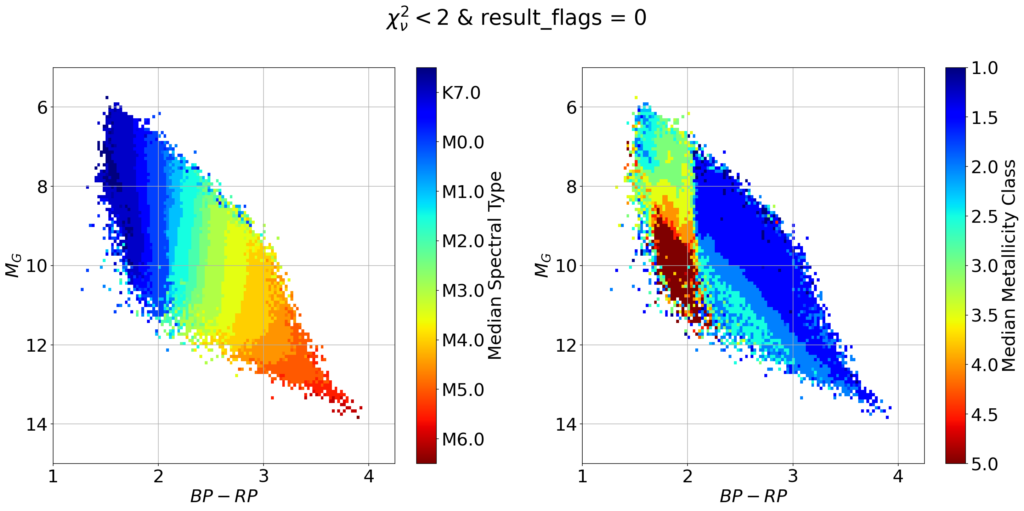
The spectral subtypes (K5.0-M8.5) based on the BOSS spectra should form a temperature sequence and map well onto the Gaia color-magnitude diagram where they should be correlated with BP-RP color (i.e along the main sequence). Similarly more metal-poor stars should appear bluer in the Gaia color-magnitude diagram compared with more metal-rich stars of similar absolute magnitude, creating a gradient across the main-sequence. We show below that both these expectations are met (with some scatter). The classifications are in general accurate to within +/-0.5 in subtype and to within +/-1.0 in metallicity class for spectra with SNR > 5 (Zhong et al. 2015).
Flags
The MdwarfType pipeline is run on all MWM BOSS spectra, including many non-M dwarfs. Poorly fit spectra tend to be classified as K5.0 subtype objects. Therefore all K5.0 subtypes have the flag_bad set and the result_flag bit 1 set.