
The current DR20 release includes spectra from 169 LVM tiles, covering a sample of Galactic and extragalactic nebulae. The sections below describe the general LVM targeting and survey footprint, explain the observing strategy, and provide details on what is contained in DR20.
LVM Targets
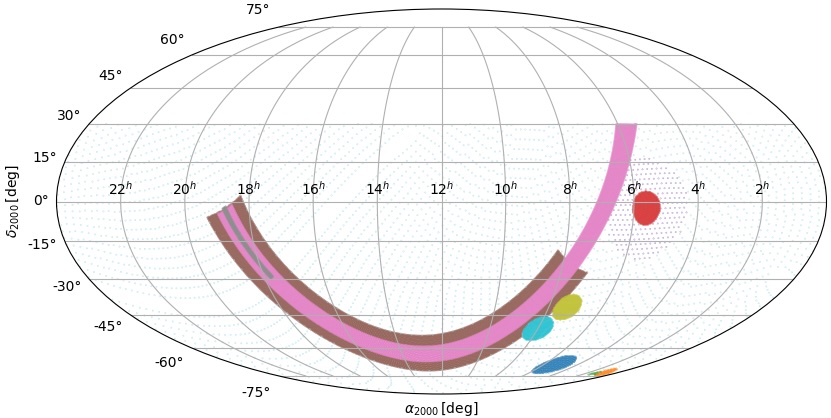
The main targets for the LVM are the Milky Way (MW) and Magellanic Clouds (LMC and SMC). The Milky Way has been split into several distinct categories: a mosaic of the galactic plane including star forming regions there, the Orion star forming region, the Gum nebula (a.k.a. Gum 12), and the THOR region, which is designed to align with the coverage of the THOR survey, a large-scale, multi-line survey of the northern Galactic plane conducted using the Jansky Very Large Array (VLA). The disks of the LMC and SMC are covered in their entirety, to their optical radius (∼R25). Additionally, the LVM has a number of lower priority targets that are observed when the higher priority targets are not visible or when conditions are not optimal, in particular during bright time. These lower priority regions include a sample of galaxies in the Local Volume (dwarf galaxies out to 5 Mpc and more massive star-forming galaxies out to 20 Mpc) and a sparse grid over the full sky. These fields are marked on the image below.
Observing Strategy
The LVM is a unique facility comprising four telescopes that split the received light between three spectrographs. As a natural consequence, it also has a unique observing strategy, designed to observe certain calibration data simultaneously with the science data to ensure the best correction for the sky background and flux calibration.
A typical observation with LVM
All science observations with the LVM have a standard exposure time of 900s. During that exposure time, the science telescope (sci) will point to the science tile for the full exposure time, and the two sky telescopes (skye and skyw) will point to two designated sky fields for the full 900s. The list of sky fields are contained in two catalogs, which were compiled using data from the Wisconsin H-Alpha Mapper (WHAM). The first catalog contains a list of sky fields distributed across the sky with a typical spacing of ~8 degrees, selected to be as dark as possible. The LVM sky fields were selected from these catalogs as those with no bright stars or emission line sources within an area larger than the FOV of the sky IFUs, aiming for a Gaia G-band surface brightness fainter than 22.5 mag/arcsec2 (roughly the sky brightness at new moon). For each science tile a ‘nearest sky tile’ is selected as the closest sky field from this catalog to the science coordinates. Since many of the LVM targets are very extended on sky, it is possible that in some cases the nearest sky tile is not particularly dark and contains contamination. As a result, the second sky telescope points to one of a smaller list of ‘darkest’ sky fields, which may be up to 30 deg away on the sky. These fields were selected by eye as being particularly dark, containing no bright stars or Milky Way line emission, and distributed across the visible sky to ensure that at least one field is visible at any time during the year. Thus, between these two sky pointings, it is possible to accurately model the sky spectrum at the position of the science field, accounting for both the sky continuum and sky emission line strength.
The fourth telescope is the spectrophotometric standard star (specphot) telescope. During the 900s exposure this telescope will observe up to 12 standard stars. these stars are selected from the Gaia DR3 catalog as isolated F type stars with G-band magnitudes in the range of 5-9 and have no significant contribution from neighbouring Gaia stars that might also fall within the specphot fiber. During each exposure, the specphot telescope will slew, acquire and observe each standard star, where the fiber-selector ensures that only one fiber is exposed to the sky at any given time. In certain conditions some standard star observations are not possible, for example in poor weather where clouds affect the acquisition. Therefore, a minimum requirement of 9 successful standard star exposures is required for each LVM science exposure to ensure that at least one standard star is detected in each spectrograph.
Exposures and dithers
Each individual science IFU exposure produces a hexagonal footprint (’tile’), where the tile center is selected based on our set of targets. Tiles covering extended objects are tessellated to ensure contiguous coverage. Due to the high (83%) filling factor and to increase our survey efficiency, we do not perform dithered observations on all targets. A brief overview of the specific strategy employed for different targets is provided below.
Milky Way (incl. the Orion and Gum Nebulae): the Milky Way tiles are observed once only, with each tile arranged to form a mosaic. Each tile has one row of fibers overlapping with its neighbours to ensure complete coverage.
Magellanic Clouds: each tile in these fields is observed with a 9-point dither pattern to ensure complete coverage of the space between the fibers, making a total exposure time of 9x900s = 8100s per tile.
Orion outskirts: the outer ring around Orion is observed with a single exposure per tile, employing a sparse grid of tiles with a 1/5th filling factor.
Local Volume Galaxies: the Local Volume galaxies are observed using the same 9x900s dithered exposure sequence as for the Magellanic Clouds. In the majority of cases, a single tile is sufficient to cover each galaxy, but in a number of more extended objects a mosaic of 7 tiles is created, where each tile consists of 9 dithered exposures.
Full Sky: the remaining sky is observed using a sparse grid of tiles with a 1/90th filling factor and a single 900s exposure time.
Target priorities and tile selection
Each set of targets has a distinct priority, with Orion being the highest priority followed by the Magellanic Clouds, Thor, Gum, Milky Way, Local Volume Galaxies and finally the full sky tiles. However, when selecting the next tile, other conditions must also be considered, such as target visibility, lunar illumination, lunar distance, airmass and shadowheight.
Within those regions that have mosaics, the tiles are selected from the centre first and then move outwards to cover the full region, except for the Milky Way in which case the tiles are selected first to have the lowest airmass.
DR20: 169 tiles across Galactic and extragalactic targets
As part of DR20 we are releasing 169 LVM tiles, with a total of ~300,000 spectra across a broad sample of targets. This includes six representative targets spanning three Galactic HII regions at different distances, a planetary nebula, and two nearby galaxies. These DR20 tiles demonstrate the exquisite data provided by LVM-I and gives the community a sampling of science-ready data, demonstrating the capabilities of the LVM. All tiles are observed following the usual LVM observing strategy defined above, although no dithered observations are released. All data are reduced with the current version (v1.2.0) of the LVM Data Reduction Pipeline (DRP), and spectral fitting is performed using the LVM Data Analysis Pipeline (DAP).
The DR20 targets include:
Rosette Nebula (NGC 2237)
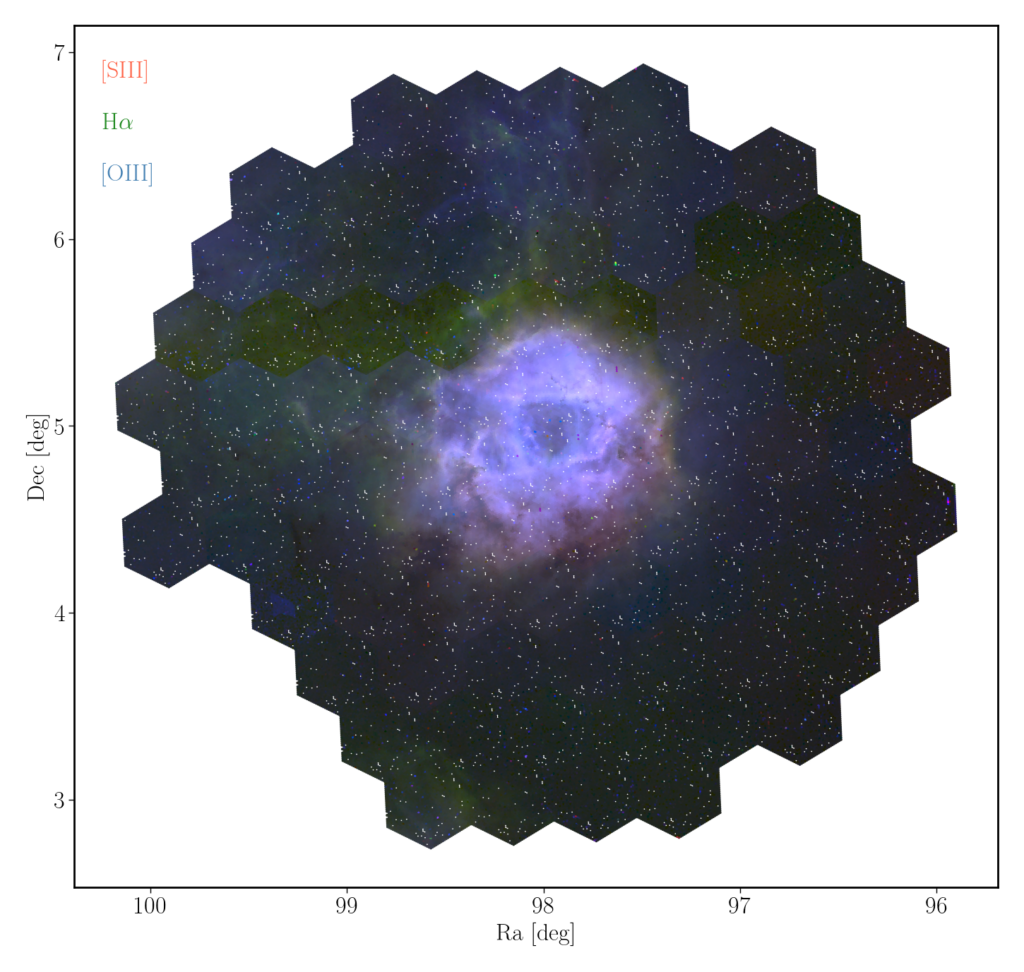
The Rosette Nebula is a well-known Galactic HII region ionized by the OB stars of the young cluster NGC 2244 and embedded within the remnant of a giant molecular cloud. This data was the focus of the study “SDSS-V LVM: Revealing the structure of the Rosette Nebula” (Villa-Durango et al. 2025) and “Unified Spectrospatial Forward Models: Spatially Continuous Maps of Weak Emission Lines in the Rosette Nebula with SDSS-V LVM” (Hilder et al. 2026).
Trifid Nebula (NGC 6514 / M20)
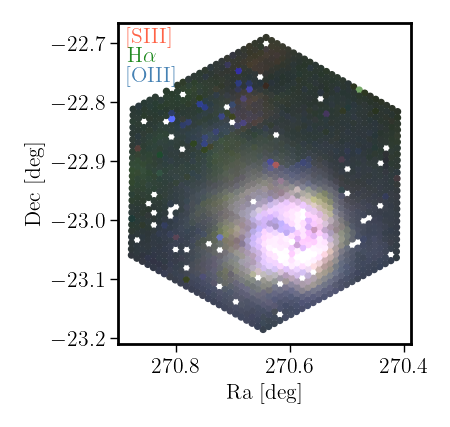
The Trifid Nebula is a compact and nearly spherical Galactic HII region, predominantly ionized by the central O star HD 164492A, and therefore represents a benchmark case for the study of a relatively simple Strömgren sphere. This target was the focus of the study “SDSS-V LVM: Resolving physical conditions in the Trifid Nebula” (Sattler et al. 2026).
Flame Nebula (NGC 2024) and Horsehead Nebula in Orion
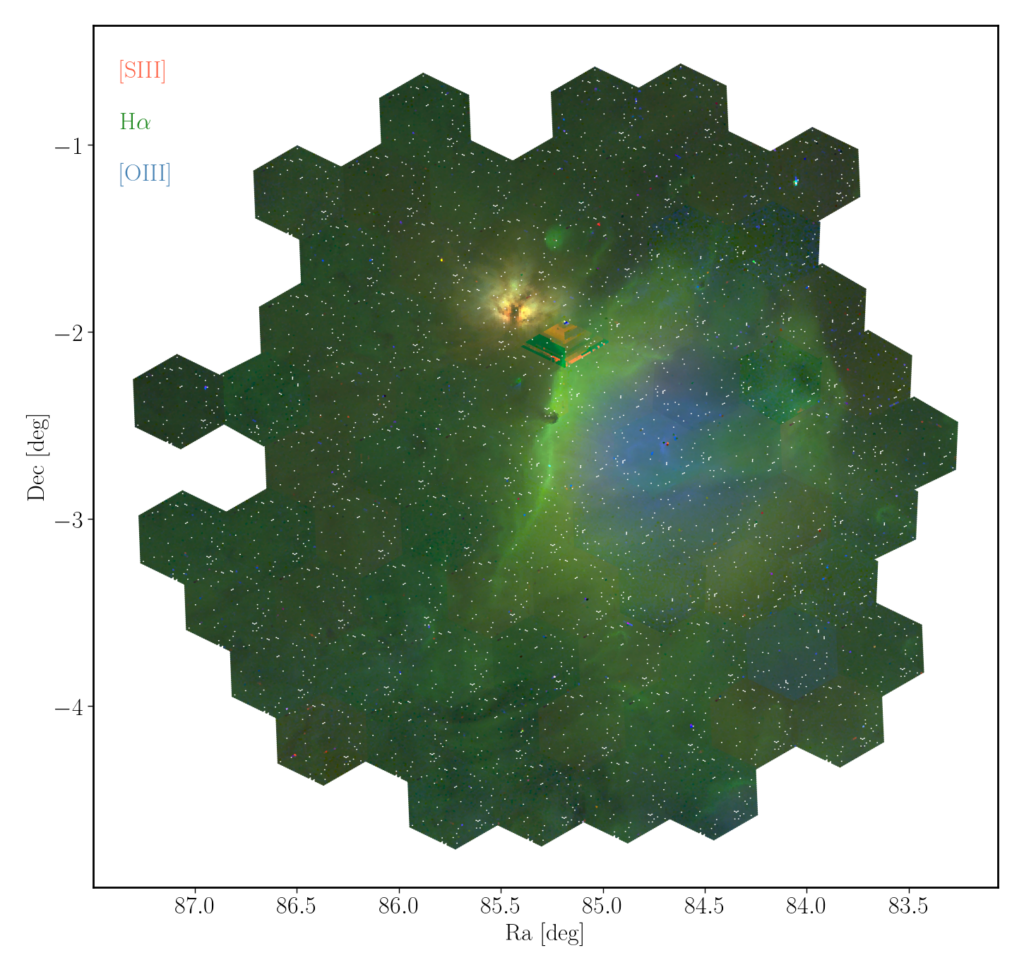
This field forms part of the Orion complex and includes the Flame Nebula (NGC 2024), IC 434, and the Horsehead Nebula at the interface with the Orion B molecular cloud. The LVM Orion observations demonstrated the ability of the survey to map the ionization structure of extended Galactic star-forming regions over very large areas, resolving the contrast between bright ionized nebulae, dark molecular structures, and photo-dissociation fronts. This data was the focus of the study “SDSS-V LVM: A glimpse into Orion” (Kreckel et al. 2024).
Helix Nebula (NGC 7293)
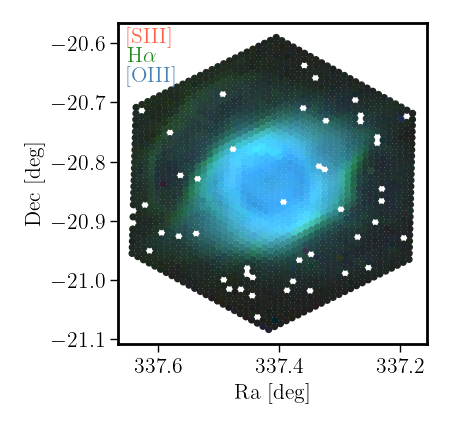
The Helix Nebula is one of the nearest and best-studied planetary nebulae, and its large angular extent makes it a particularly well matched target for the LVM field of view. The LVM observations provide spatially resolved maps of the principal ionic species across most of the nebula in a single pointing, revealing the classical ionization stratification from the compact He++ core to the bright [O III] ring and the extended low-ionization envelope. This data was the focus of the study “SDSS-V LVM: Helix Nebula Public data, Data Analysis Pipeline data products” (Sanchez et al. 2026).
NGC 4945
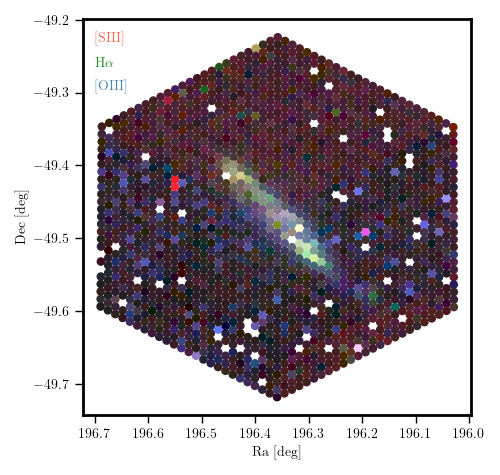
NGC 4945 is a nearby (D ~ 3.8 Mpc), nearly edge-on starburst galaxy hosting both intense central star formation and a Seyfert 2 nucleus, making it one of the nearest composite AGN–starburst systems. It illustrates the capability of LVM to target nearby galaxies with resolved feedback-driven extraplanar emission. This data release includes only one position from the set of 9 dithers.
M33 (NGC 598)
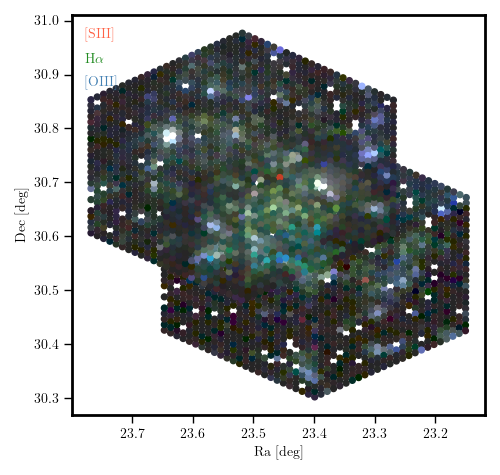
M 33 is the nearest massive late-type galaxy in the northern Local Group and provides an important bridge between Galactic resolved nebulae and galaxy-wide external systems. Its distance (D ~ 840 kpc) and angular size are well placed to combine the analysis of resolved, partially resolved, and integrated stellar populations, in combination with multiwavelength datasets covering from X-ray to atomic and molecular gas