
- Summary
- Gaia-unWISE AGN survey
- Bright Low-Redshift Galaxy Survey
- BHM Cartons for FPS Commissioning
- Observational goals and requirements
- Target selection and survey implementation
- Targeting generations used in early FPS operations
- Targeting generations used during the bulk of FPS operations
- Targeting generation used during SDSS-V plate operations
- BHM-centric open fiber programs
- Spectroscopic data released in DR20
Summary
The BHM project has a number of ancillary spectroscopic programs, which provide scientifically interesting targets when BOSS fibers are not assigned to core science projects. These have the goal of obtaining redshifts and classifications for candidate QSOs and bright galaxies selected via wide-area optical/IR surveys. These supplementary programs do not affect the overall SDSS-V MOS survey plan (allocation of exposure resources across the sky).
Gaia-unWISE AGN survey
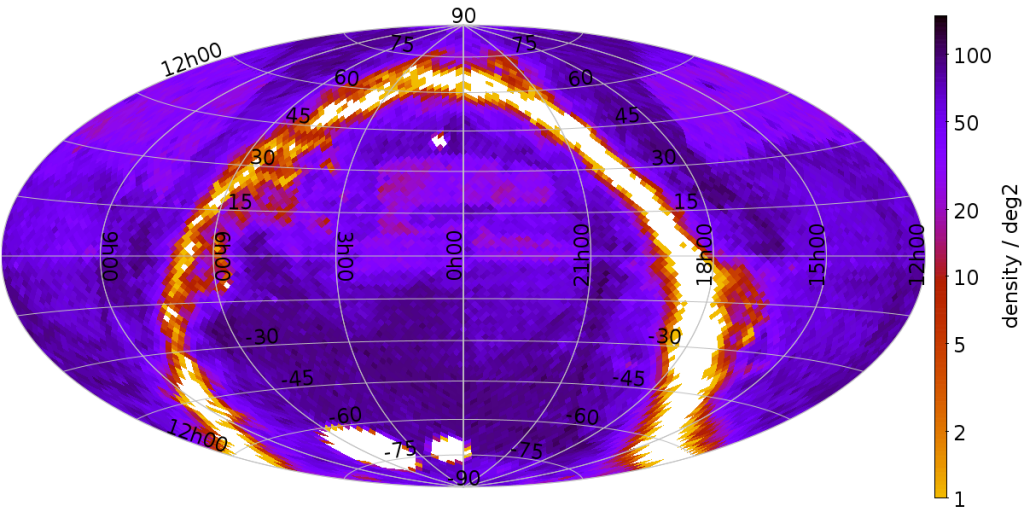
This BHM-led program collects BOSS spectroscopy for a large sample of candidate QSOs. We downselect targets suitable for SDSS-V spectroscopy from the parent sample presented by Shu et al. (2019), who used applied a machine-learning approach to a combination of the Gaia DR2 and unWISE catalogues. The Gaia-unWISE AGN targets are distributed across almost the entire sky (except for the innermost Galactic plane and regions around the Magellanic Clouds), and so are well matched to the SDSS-V all-sky survey strategy. This is primarily a discovery program, and so we have excluded AGN targets having existing good quality optical spectroscopy in earlier SDSS iterations.
Bright Low-Redshift Galaxy Survey
This program seeks to measure redshifts and provide classifications for a sample of optically bright, low-redshift, morphologically resolved galaxies, initially selected from LegacySurvey DR8 optical/IR catalogues, later updated to LegacySurvey DR10. This program is primarily intended as a filler, with no expectation of a high degree of spectroscopic completeness.
BHM Cartons for FPS Commissioning
In order to support FPS commissioning tests, we defined two cartons (manual_bhm_spiders_comm, manual_bhm_spiders_comm_lco) of X-ray selected targets having known redshifts. These targets were drawn from the eFEDS/SDSS-V sample presented by Aydar, et al (2025). This carton was used to check the ability of the whole SDSS-V system (telescope, FPS, spectrograph and data reduction pipelines) to collect reliable redshifts for SPIDERS-like targets.
Observational goals and requirements
The SDSS-V/BHM Ancillary projects seek to gather spectroscopic redshifts and classifications for large samples of candidate QSOs and galaxies.
These samples generally have only moderate surface density on the sky, and so benefit most from the widest area components of the SDSS-V survey.
Target selection and survey implementation
Further details of the algorithms and criteria used to select BHM ancillary target cartons are provided via the links below.
Targeting generations used in early FPS operations
The ‘v0.5.epsilon-7-core-0’, ‘v0.5.2’, ‘v0.5.3’, and ‘v0.5.5’ targeting generations were used during SDSS-V/FPS operations (2022-2023). These generations are identical from the point of view of BHM Ancillary program targeting. The ‘v1.0.2’, ‘v1.0.3’, ‘v1.0.4’, ‘v1.0.5’, ‘v1.0.5-boss-only’, and ‘dr20.manual’ targeting generations were used for SDSS-V/FPS operations (2023-2025). These generations are identical from the point of view of BHM Ancillary program targeting.
Below is a list of BHM Ancillary cartons that were considered (the carton names link to detailed descriptions):
Targeting generations used during the bulk of FPS operations
The ‘v1.0.2’, ‘v1.0.3’, ‘v1.0.4’, ‘v1.0.5’, and ‘v1.0.5-boss-only’ targeting generations were used during the bulk of SDSS-V/FPS operations (2023-2025) that are being released in DR20. The first three of these targeting generations are identical from the point of view of BHM Ancillary targeting. In the ‘v1.0.5’ and ‘v1.0.5-boss-only’ targeting generations we introduced additional shallower “*_d3” versions of GUA and Bright Galaxy cartons (where faint targets have lower exposure time requests). Below is a list of BHM Ancillary cartons that were considered during this phase:
Targeting generation used during SDSS-V plate operations
The ‘v0.plates’ targeting generation was used during the first year of SDSS-V operations at APO when the old plug plate system was still in place. We included early versions of the Gaia/unWISE AGN cartons during this phase.
Below is a list of BHM Ancillary cartons that were considered (the carton names link to detailed descriptions):
BHM-centric open fiber programs
A subset of the SDSS-V Open Fiber Program focus on BOSS (re-)observations of optical/IR/X-ray selected QSOs/AGN or other extragalactic targets, and so have strong overlap with BHM’s core science themes.
An initial set of six open fiber programs used from the start of FPS operations are listed below.
openfibertargets_nov2020_11: All QSOs/AGN, Quasars Second Epochs for SDSS-I/II Quasars observed only onceopenfibertargets_nov2020_18: All QSOs/AGN, Hard X-ray Sources; 10,000 hard-band selected X-ray sources (complementing the soft X-ray selection from eROSITA in SPIDERS)openfibertargets_nov2020_26: All QSOs/AGN, Quasar Winds; long-term spectroscopic monitoring of quasar winds through additional epochs on previously well-observed BAL quasarsopenfibertargets_nov2020_27: All QSOs/AGN, All Bright Quasars; All QSO candidates with G<20, based on WISE colors and optical informationopenfibertargets_nov2020_30: All QSOs/AGN, JWST North Ecliptic Pole Time Domain regionopenfibertargets_nov2020_33: All QSOs/AGN, Variability-Selected AGN and Blazars; Confirmation and Characterization of Variability-selected AGN, QSOs, and Blazars
A further call for targets in June 2024 led to the following seven BHM-related openfiber cartons:
- openfibertargets_bhm_racsradio_boss: Optically bright counterparts to bright 888 MHz radio sources identified by in the ASKAP/RACS-low survey (Hale et al., 2021).
- openfibertargets_bhm_varagn_boss: Optical variability selected AGN candidates from ZTF.
- openfibertargets_bhm_morexray_boss: Counterparts of X-ray sources identified by Swift-XRT and XMM-Newton.
- openfibertargets_bhm_hightderates_psb_boss: Galaxies that have been photometrically identified as or post-starburst (E+A, French & Zabludoff 2018). Such galaxies are known to have an elevated rate of tidal disruption events of stars by their supermassive black holes.
- openfibertargets_bhm_hightderates_qbs_boss: Galaxies that have been photometrically identified as quiescent Balmer-strong (QBS, French & Zabludoff 2018). Such galaxies are known to have an elevated rate of tidal disruption events of stars by their supermassive black holes.
- openfibertargets_bhm_quaia_boss: Quasar candidates from the Quaia Catalog (Storey-Fisher et al., 2024) that have not previously been spectroscopically observed by any generation of SDSS.
- openfibertargets_bhm_lofarradio_boss: Optically bright counterparts of low-frequency radio sources identified by LOFAR Two Metre Sky Survey (LOTSS DR2, Hardcastle et al., 2023)
The Open Fiber programs were not used during the SDSS-V plate program.
Spectroscopic data released in DR20
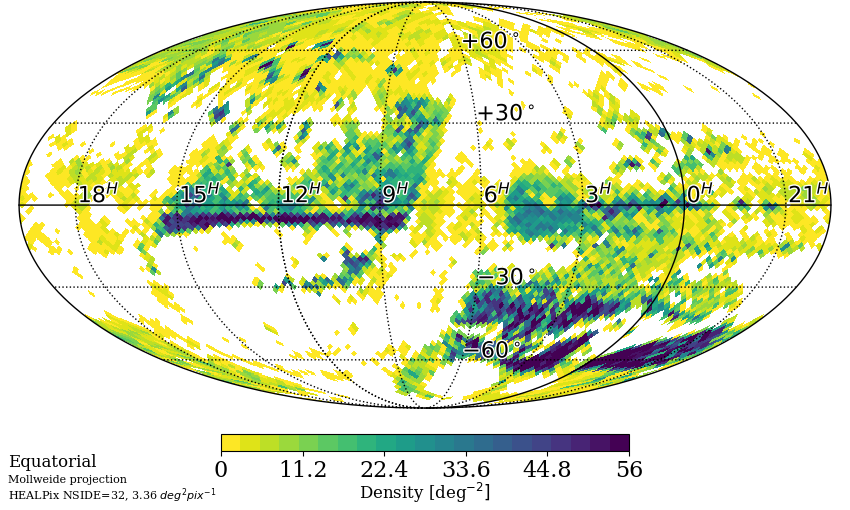
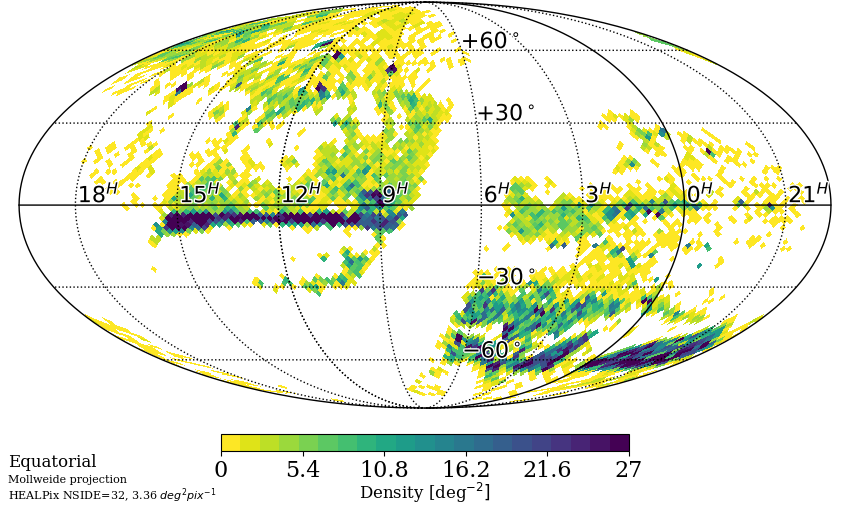
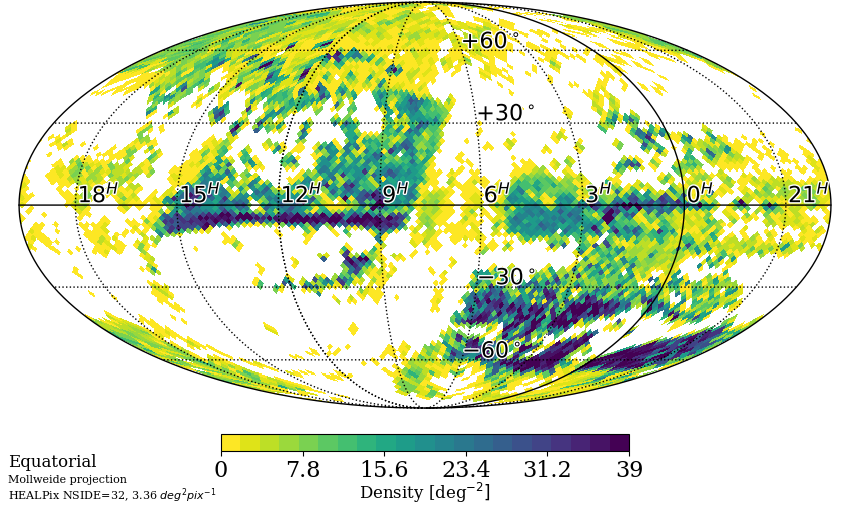
The number of BHM Ancillary and BHM-centric open fiber program spectra in DR20 are given in the table below.
| (First)Carton name | Ndaily | Nepoch | Nallepoch | Unique targets |
|---|---|---|---|---|
| bhm_gua_dark | 158119 | 143121 | 81734 | 84809 |
| bhm_gua_bright | 53875 | 50828 | 31589 | 33020 |
| bhm_colr_galaxies_lsdr8 | 28655 | 23743 | 16308 | 16893 |
| openfibertargets_bhm_quaia_boss | 24920 | 24889 | 22957 | 23905 |
| bhm_colr_galaxies_lsdr10 | 19673 | 18893 | 14111 | 14137 |
| bhm_gua_dark_d3 | 18475 | 18283 | 17593 | 17736 |
| openfibertargets_nov2020_27 | 7373 | 7087 | 4521 | 6563 |
| openfibertargets_bhm_lofarradio_boss | 6000 | 5998 | 3816 | 5913 |
| openfibertargets_bhm_racsradio_boss | 3487 | 3477 | 2363 | 3370 |
| openfibertargets_nov2020_33 | 2338 | 2321 | 1762 | 2136 |
| openfibertargets_bhm_morexray_boss | 1822 | 1799 | 903 | 1749 |
| openfibertargets_nov2020_18 | 1080 | 1046 | 490 | 940 |
| openfibertargets_nov2020_11 | 682 | 672 | 77 | 649 |
| bhm_colr_galaxies_lsdr10_d3 | 230 | 224 | 214 | 214 |
| openfibertargets_bhm_hightderates_qbs_boss | 132 | 128 | 44 | 127 |
| openfibertargets_bhm_varagn_boss | 30 | 30 | 7 | 30 |
| openfibertargets_bhm_hightderates_psb_boss | 25 | 25 | 7 | 25 |
| openfibertargets_nov2020_26 | 16 | 16 | 8 | 16 |
Back to Black Hole Mapper Science Programs