
Summary
The Chandra Source Catalog (CSC) followup program uses SDSS-V spectroscopy to characterize the optical/NIR counterparts of Chandra X-ray sources. Spectra will provide redshifts and source classifications for AGN, galaxies and stars with active X-ray emission detected in the Chandra Source Catalog that have been matched to counterparts in the PanSTARRS-1, Legacy, and 2MASS catalogs. Chandra X-ray imaging provides excellent sensitivity and unparalleled spatial resolution, unveiling a different population of sources than other X-ray missions.
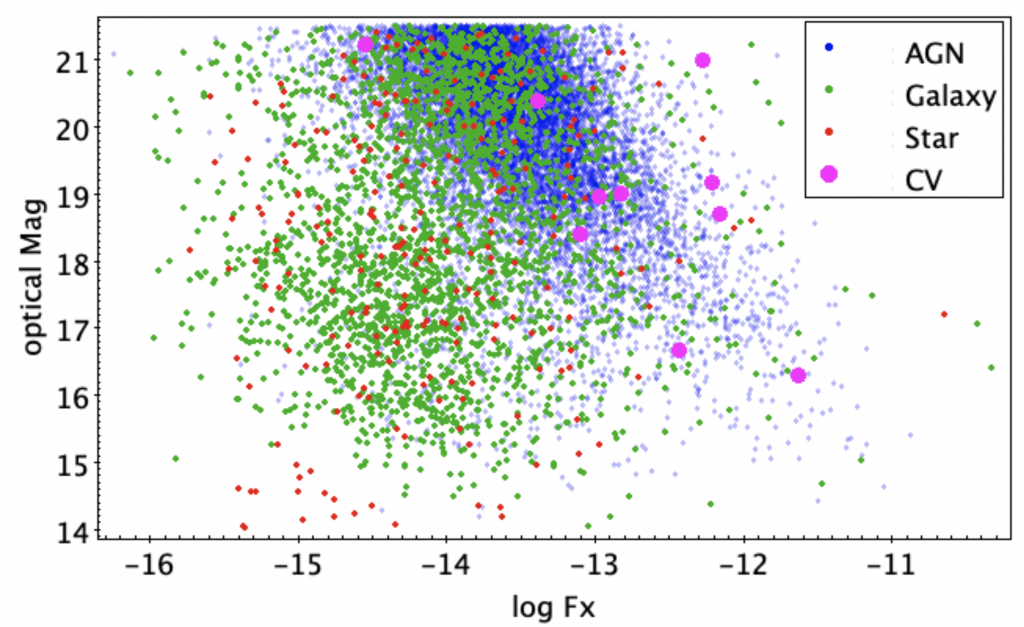
Observational goals and requirements
The BHM CSC project seeks to gather optical and IR spectroscopy for a large sample of X-ray selected sources discovered (mostly) serendipitously via uniform processing of the Chandra data archive – the Chandra Source Catalogue.
For the majority of the CSC sources, the immediate goal is to obtain redshifts and classifications for the optical counterparts to the X-ray sources (selected from the PanSTARRS, Legacy and Gaia catalogues). For a smaller subset of CSC sources, the X-ray detections are associated with NIR-bright 2MASS objects. For these targets, expected to be Galactic stars, we are collecting APOGEE H-band spectroscopy for classification purposes.
Target selection and survey implementation
CSC targets require either optical BOSS spectroscopy, or APOGEE NIR spectroscopy.
CSC targets having existing SDSS archival spectroscopy are de-prioritized w.r.t. unobserved targets
BOSS exposure time requests (cadences) are determined according to apparent magnitude, based on past experience obtaining redshifts for counterparts to X-ray sources.
To identify Chandra X-ray sources with optical/infrared counterparts suitable for SDSS-V spectroscopic follow-up, we used the NWAY probabilistic cross-matching algorithm of Salvato et al. (2018) to match 362,310 CSC~2 X-ray sources (using the production-current database of 14 November 2022, restricted to sources with positive flux in at least one band) to Gaia DR3, Legacy Survey DR10, Pan-STARRS1 DR2, and 2MASS. To remain within the magnitude limits of the SDSS-V Black Hole Mapper, we restricted Gaia counterparts to 14 < G < 20 and Legacy Survey or Pan-STARRS1 counterparts to 14 < mag < 21.5 in at least one of the g, r, or z bands. We additionally retained 2MASS counterparts with H<14 to enable APOGEE follow-up. Existing optical or infrared spectroscopy was not used as a selection criterion.
Yet further details of small adjustments in the algorithms and criteria used to select CSC target cartons are given in the discussion and links below.
Targeting generations used during early FPS operations
The ‘v0.5.2’, ‘v0.5.3’ and ‘v0.5.5’ targeting generations were used during initial SDSS-V/FPS science operations (2022-2023). These three generations are identical from the point of view of CSC targeting. In addition, an earlier targeting_generation (‘v0.5.epsilon-7-core-0’) was used for FPS commissioning observations, which contains earlier versions of the CSC cartons.
Below is a list of BHM CSC cartons that were considered in the ‘v0.5.2’, ‘v0.5.3’ and ‘v0.5.5’ targeting generations (the carton names link to detailed descriptions):
Below is a list of BHM CSC cartons that were considered in the ”v0.5.epsilon-7-core-0′ targeting generation:
Targeting generations used during the bulk of FPS operations
The ‘v1.0.2’, ‘v1.0.3’, ‘v1.0.4’, ‘v1.0.5’, and ‘v1.0.5-boss-only’ targeting generations were used during the bulk of SDSS-V/FPS operations (2023-2025) being released in DR20. These targeting generations are fairly similar from the point of view of CSC targeting. In the ‘v1.0.5’ and ‘v1.0.5-boss-only’ targeting generations we introduced the ‘bhm_csc_boss_d3′ carton (where faint targets have shorter exposure time requests). The ‘bhm_csc_apogee’ carton was necessarily excluded from the ‘v1.0.5-boss-only’ targeting generation.
Targeting generation used during SDSS-V plate operations
The ‘v0.plates’ targeting generation was used during the first year of SDSS-V operations at APO when the old plug plate system was still in place. We included early versions of the AQMES cartons during this phase, as listed below:
Spectroscopic data released in DR20
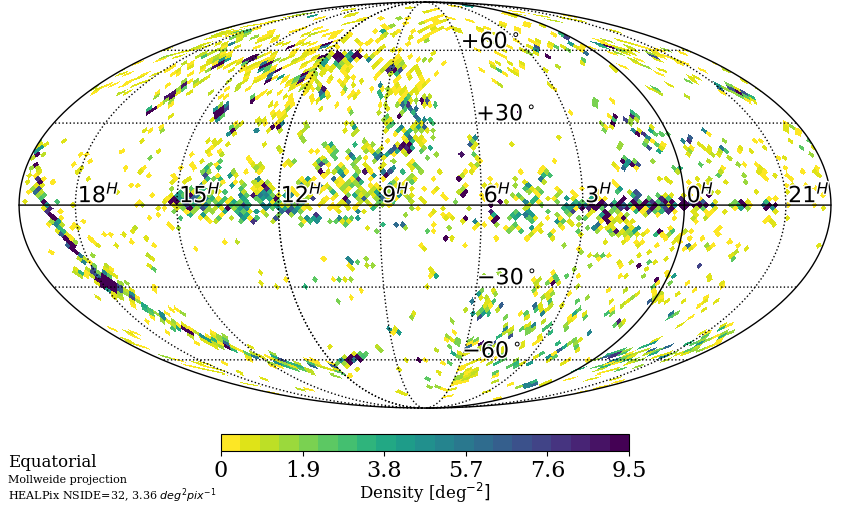
The numbers of BHM CSC BOSS spectra in DR20, and the sky distribution of observed (BOSS) targets are illustrated in the figure and table below.
| (First)Carton name | Ndaily | Nepoch | Nepoch | Unique targets |
|---|---|---|---|---|
| bhm_csc_boss | 24362 | 20688 | 12465 | 12924 |
| bhm_csc_boss_dark | 11037 | 7613 | 1925 | 2872 |
| bhm_csc_boss_d3 | 1009 | 916 | 837 | 866 |
| bhm_csc_boss_bright | 739 | 340 | 153 | 194 |
Back to Black Hole Mapper Science Programs