
Summary
The SDSS-V/BHM Reverberation Mapping (RM) project seeks to measure the time lag between variability signals in the quasar continuum and the response/echo from the broad emission lines, and hence make virial black hole (BH) mass estimates; aiming for a large and uniformly selected sample of quasars across a wide range of luminosities and redshifts. The target sample is flux-limited without other cuts (though there are priorities) on quasar properties, to ensure it is representative of the general quasar population. The sample size is aimed to be large enough (> 1000 quasars) to be among the premier near-term RM studies, roughly an order of magnitude more comprehensive than the historical RM studies of primarily nearby and low-luminosity AGN.
The primary broad emission lines of interest are Hα/Hβ, MgII 2798, and CIV 1549, and are covered by BOSS optical spectroscopy; the sample extends to the highest redshifts reasonably feasible with optical spectroscopy (e.g., z~4.5). The spectroscopic monitoring data is aimed to be of sufficient temporal coverage and signal-to-noise ratio (SNR) to measure the correlated and delayed variability in the broad-line flux and in the continuum flux.
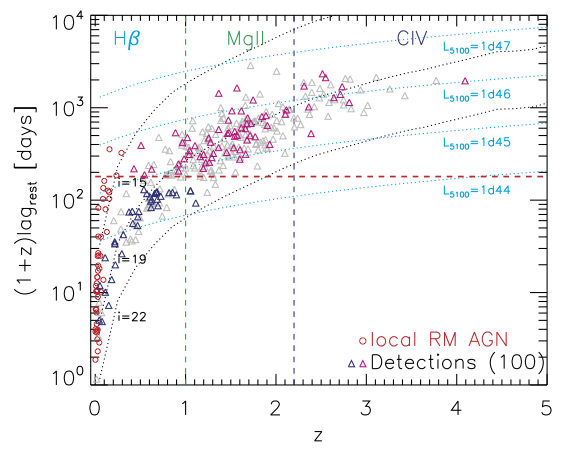
BHM/RM aims to have sufficient time-sampling and SNR to detect lags in at least one broad line per quasar for of order 1/2 the sample, under the assumption that high-redshift quasars have lags consistent with predictions from the lag-luminosity relation observed for low-z AGN. Given the sample characteristics, the expected broad-line lags range from days to several years in the observed frame. Therefore the overall cadence has both dense sampling, i.e., every few nights, to resolve short lags at low redshift, and sparse sampling, e.g., weekly to monthly, to cover long lags at high redshifts.
Observational goals and requirements
The RM program seeks to gather high SNR, high cadence, long baseline spectroscopy for more than 1000 broad line emitting quasars in well-known extragalactic survey fields. This project is a continuation and expansion of the reverberation mapping experiment carried out in SDSS-III and SDSS-IV.
To meet our science goal of measuring reverberation lags for at least half of the targeting quasar sample, we will observe four or five fields with of order ~102 epochs of spectroscopy, with revisit times as short as 3 days. The RM fields will be observed for as long a season as possible (stopping when they are visible above an airmass of ~1.4 for less than ~2 hours per night).
The nominal open-shutter exposure time per RM epoch is 2 hours (8x15min exposures), which from earlier experience with the SDSS/BOSS instrument has been demonstrated to provide adequate SNR for reverberation mapping science. In practice, we consider an RM epoch complete when the accumulated SN^2 (at a fiducial magnitude of g_psfmag=21.2, as measured by the on-mountain quick-reduction pipeline SOS) exceeds 10 and 20 in the blue and red arms of the BOSS spectrograph, respectively.
Target selection and survey implementation
The RM target selection is derived from a sample of candidate broad-line quasars selected using the methods described by Yang and Shen (2022), complemented by a large number of previously spectroscopically confirmed quasars from the literature. The RM targets are grouped into four overlapping target ‘cartons’ according to their selection method:
- Confirmed QSOs that have been identified through previous spectroscopic projects ->
bhm_rm_known_spec - QSO candidates selected on the basis of the Skew-T method of Yang and Shen (2022) ->
bhm_rm_core - QSO candidates selected through their optical photometric variability properties ->
bhm_rm_var - QSO candidates selected by ancillary methods ->
bhm_rm_ancillary
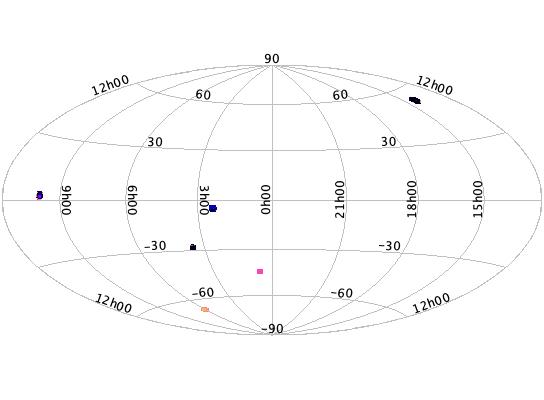
The RM targets lie primarily in one of five carefully chosen fields (COSMOS, SDSS-RM, XMM-LSS, CDFS, ELAIS-S1); see those five with boldfaced ‘Field name’s in the table below. Note, however that ELAIS-S1 was not yet intensively observed yet in DR20, and so has very limited reconnaissance data released so far in DR20. [The Southern S-CVZ/SEP was a potential backup RM (and eROSITA) field, but again has very limited reconnaissance data anticipated in DR20, and even through the end of SDSS-V].
| Field name | Obser- vatory | RA (deg) | Dec (deg) | Cadence | Notes |
|---|---|---|---|---|---|
| COSMOS | APO | 150.0 | +2.2 | dark_174x8 | |
| SDSS-RM | APO | 213.7042 | +53.08333 | dark_174x8 | Continuation of SDSS-III,IV RM monitoring |
| XMM-LSS | APO | 35.70833 | -5.05000 | dark_174x8 | |
| CDFS | LCO | 52.65 | -28.1 | dark_174x8 | southern RM field |
| S-CVZ/SEP | LCO | 90.0 | -66.56056 | dark_100x8 | eROSITA CVZ (and a backup RM field) |
| ELAIS-S1 | LCO | 9.450 | -44.0 | dark_100x8 | upcoming southern RM field |
The radius of the field is chosen to match the useful Field of View (FoV) at each observatory (~5.3 sq. deg at APO, ~2.3 sq. deg at LCO).
RM fields are observed during dark and gray time with a cadence of ~3-8 days, generally resulting in 5-7 epochs per month (depending on weather conditions). The RM fields are monitored over 5-7 months each year, using the maximum seasonal length for which the fields are observable with airmass < 1.4. All RM targets within a field receive the same cadence.
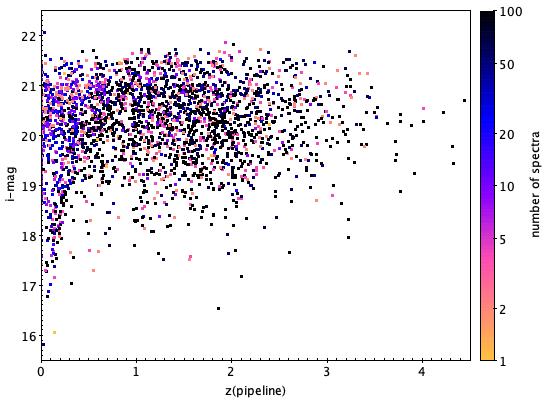
Target prioritization within the RM program is designed to firstly favor optically brighter targets, and for targets of approximately similar brightness, to prefer spectroscopically confirmed QSOs over QSO candidates. The RM targets generally span the magnitude range 16 < i_psfmag < 21.7.
During the course of collecting spectroscopic observations of RM targets we have identified a small number of non-broad-line AGN interlopers in the sample. These objects have been removed from subsequent iterations of RM target selection through the use of a veto table.
Further details of the algorithms and criteria used to select RM target cartons can be found via the links provided below.
Targeting generations used during early FPS operations
The ‘v0.5.epsilon-7-core-0’, ‘v0.5.2’, ‘v0.5.3’ and ‘v0.5.5’ targeting generations were used during initial SDSS-V/FPS operations (2022-2023). These generations are identical (to each other) from the point of view of RM targeting.
Below is a list of BHM RM cartons that were considered in this phase (the carton names link to detailed descriptions):
Targeting generations used during the bulk of FPS operations
The ‘v1.0.2’, ‘v1.0.3’, ‘v1.0.4’, ‘v1.0.5’, ‘v1.0.5-boss-only’, and ‘dr20.manual’ targeting generations were used during the bulk of SDSS-V/FPS operations (2023-2025) that are being released in DR20. The first five of these targeting generations are identical from the point of view of RM targeting. The ‘dr20.manual’ generation was introduced later, and includes slightly revised versions of the RM cartons.
RM cartons in the ‘v1.0.2’, ‘v1.0.3’, ‘v1.0.4’, ‘v1.0.5’, ‘v1.0.5-boss-only’ targeting generations:
RM cartons in the ‘dr20.manual’ targeting generation
Targeting generation used during SDSS-V plate operations
The ‘v0.plates’ targeting generation was used during the first year of SDSS-V operations at APO when the old plug plate system was still in place. We included early versions of the RM cartons during this phase.
Below is a list of RM cartons that were considered (the carton names link to detailed descriptions):
Spectroscopic data released in DR20
In DR20, SDSS-V some (at least limited) data connected to RM are released across all six potential fields, but especially emphasizing the three fields routinely observed from APO (COSMOS, SDSS-RM, and XMM-LSS fields), as well as the fourth main RM field (CDFS) observed extensively; the bulk of data from the 5th main field (ELAIS-S1) will be included in later data releases. DR20 includes aprooximately ~184,000 spectra for nearly ~2900 distinct RM targets, the bulk of which are repeat high-cadence spectroscopy for ~380 primary RM science targets in each of the COSMOS, SDSS-RM, XMM-LSS , and CDFS fields.
The number of BHM RM BOSS spectra in DR20 are given in the table below.
| (First)Carton name | Ndaily | Nepoch | Unique targets |
|---|---|---|---|
| bhm_rm_known_spec | 128081 | 88125 | 1880 |
| bhm_rm_core | 42261 | 27714 | 1654 |
| bhm_rm_ancillary | 6473 | 4555 | 283 |
| bhm_rm_var | 6034 | 4016 | 163 |
| bhm_rm_xrayqso | 935 | 662 | 12 |
Back to Black Hole Mapper Science Programs