
- Summary
- The SDSS-V SPIDERS hemisphere survey
- The SDSS-V/eFEDS pilot survey
- Clarification of SPIDERS+eFEDS scope and timeline
- Observational goals and requirements
- SPIDERS Hemisphere survey
- SDSS-V/eFEDS pathfinder survey
- Target selection and survey implementation
- Targeting generations used during early FPS operations
- Targeting generations used during the bulk of FPS operations
- Targeting generation used during SDSS-V plate operations
- Spectroscopic data released in DR20
- SPIDERS spectra from FPS commissioning
SPectroscopic IDentfication of ERosita Sources
Summary
The SDSS-V/BHM SPectroscopic IDentfication of ERosita Sources (SPIDERS) project aims to characterize a large sample of X-ray sources through an ambitious program of optical spectroscopic follow up.
SPIDERS has two main science themes – the follow up of X-ray point-like sources (‘SPIDERS-AGN’), and the follow up of X-ray/optical cluster candidates ( ‘SPIDERS-Clusters’).
The SPIDERS project is exploring the X-ray source population through the wide and deep X-ray surveys performed with the SRG/eROSITA X-ray telescope (Predehl et al. 2021). In particular we focus on the sky hemisphere for which the Max Planck Institute for Extraterrestrial Physics (MPE) has data rights (approx. 180 < l < 360 deg, Merloni et al. 2024), and on the eROSITA performance validation observations of a smaller (but deeper) pilot field (a.k.a. ‘eFEDS’, Brunner et al. 2022).
The SDSS-V SPIDERS hemisphere survey
The hemisphere survey is the main component of the SDSS-V SPIDERS program. We seek to obtain highly complete (80-85%) optical spectroscopic information (redshifts, classifications) for a large sample (>250,000) of point-like X-ray selected targets over >10,000 deg2 of high Galactic latitude sky. The SPIDERS hemisphere sample will reach to X-ray flux limits of 2×10-14 erg/cm2/s and to optical magnitudes of i ~ 21.3, r~21.5 AB. In addition, over the same sky area, we aim to obtain redshifts for >50,000 galaxies in >10,000 clusters, selected via their X-ray and optical properties (Kluge et al. 2024).
The SDSS-V/eFEDS pilot survey
The SDSS-V/eFEDS survey was a pathfinder component of the BHM survey program, led by the SPIDERS team. The SDSS-V/eFEDS survey exploits early performance validation observations from the SRG/eROSITA X-ray telescope in the ‘eROSITA Final Equatorial Depth Survey’ field (eFEDS, Brunner et al. 2022). The eFEDS X-ray footprint covers around 140 sq. degrees centered near RA,Dec = 135,+1 deg, and includes the ‘GAMA09’ Field (Driver et al. 2008). In SDSS-V we used pre-FPS (i.e. plate mode) observations at the Apache Point Observatory SDSS/2.5m telescope to collect optical spectroscopy for counterparts to point-like and extended X-ray sources in eFEDS (Salvato et al. 2022; Ider Chitham et al. 2020). The SDSS-V/eFEDS sample reaches to an X-ray flux limit approximately twice as deep as that pursued by the Hemisphere survey, whilst the optical magnitude limit is comparable. The SDSS-V/eFEDS program builds upon earlier efforts (by our team and others) to obtain spectroscopy for galaxies, AGN and stars in this well-known survey field.
The full eFEDS spectroscopic sample, including more than 12k X-ray sources with secure spectroscopic redshifts and classifications, is presented by Aydar et al. (2025).
Clarification of SPIDERS+eFEDS scope and timeline
The SPIDERS project was originally conceived in response to the call for ideas for a program to follow on from SDSS-III. At that time (c. 2013), it was expected that SRG/eROSITA would shortly be launched and start providing targets for observation within/alongside the SDSS-IV/eBOSS survey. Whilst waiting for the launch of SRG, initial SDSS-IV/SPIDERS target selection was based on ROSAT and XMM-Newton Slew Survey X-ray catalogs (Dwelly et al. 2007; Clerc et al. 2016). The final results from the pre-eROSITA phase of SPIDERS are described by Comparat et al. (2020), Clerc et al. (2020) and Kirkpatrick et al. (2021). Due to delays, eROSITA only started gathering all-sky survey data in late 2019, a few months before the nominal end of SDSS-IV/eBOSS operations (early 2020). In order to recover some of the SPIDERS science goals, we carried out a mini-survey of the eFEDS field towards the end of the SDSS-IV survey (Northern Spring 2020). That project was interrupted by the COVID-19 pandemic, and only a small fraction of the expected data set was collected.
The SPIDERS project has been continued and updated for SDSS-V, forming one pillar of the SDSS-V/Black Hole Mapper project. SDSS-V/SPIDERS includes early plate-based observations to recover and expand upon the SDSS coverage of the eFEDS field (Dec 2020-May 2021), followed by very wide area coverage of the high-latitude eROSITA sky using the new twin SDSS-V/FPS robotic fiber positioner systems (2022-). Selection of SPIDERS targets for the initial phase of FPS operations (until July 2023) was based on eRASS1 depth X-ray data (single pass coverage using 6 months of eROSITA survey data). When deeper eROSITA data became available, we updated SPIDERS AGN target selection (from Aug 2023) to be mostly based on eRASS:3 depth data (three passes over the sky, using 18 months of eROSITA survey data), and in some cases (clusters, SEP) even deeper eROSITA data were used.
Observational goals and requirements
SPIDERS Hemisphere survey
The primary observational goal of the SPIDERS (West Galactic) hemisphere program is to obtain a highly complete set of reliable spectroscopic redshifts and classifications for optical/IR counterparts to eROSITA X-ray sources.
SPIDERS will spectroscopically target >250,000 optically bright (r < 21.5 or i < 21.3 AB) counterparts of X-ray sources, distributed over a high Galactic latitude survey footprint >10,000 deg2. SPIDERS will use the part of the eROSITA All Sky Survey data set which lies in the ‘MPE’ hemisphere (approx. 180<l<360 deg). Initial SPIDERS Hemisphere target selection is based on ‘eRASS1’ depth data (first 6-months eROSITA scanning data), and extended to ‘eRASS:3’ data (18 months depth), reaching to a X-ray flux limit of ∼2×10-14 erg cm-2 s-1 (in the 0.5-2 keV band).
We expect X-ray emitting AGN to be the dominant source of counterparts to point-like X-ray sources, but with significant numbers of galaxies and stars also observed. We will also obtain optical spectra of ∼104 X-ray emitting clusters of galaxies (typically targeting 3-10 member galaxies per cluster), for cluster astrophysics and cosmology studies.
Target priorities are allocated within the SPIDERS ‘AGN-centric’ samples according to several factors, including: the X-ray detection likelihood, the cross-match method and reliability, the availability of an earlier good-quality SDSS spectrum, and Galactic latitude. SPIDERS clusters galaxy targets are prioritized according to the relative probability of them being a cluster member, with candidate BCGs given first priority.
SPIDERS targets need to reach a sufficient SNR to guarantee a very high redshift success rate (spectroscopic completeness). Based on a large visually inspected sample of X-ray selected sources observed by BOSS, we estimate that spectra having a median SNR/pixel>2 will ensure a >85% redshift success rate for SPIDERS AGN. Simple scaling from BOSS performance in SDSS-III/IV suggests that nominal exposure times of (3-4)x15 minutes in dark-time will be sufficient for SPIDERS targets, given the magnitude limits of (r < 21.5 or i < 21.3 AB). The choice of cadence per target is driven by the total expected BOSS exposure time that is required to achieve reliable redshifts; brighter targets have shorter exposure time requests.
In late 2024 we made major adjustments to the FPS survey strategy for covering wide area high-latitude fields during dark time. This change meant that in most fields cases changed from being allocated a ‘dark_2x2‘ cadence to a 'dark_1x3‘ cadence, i.e. swapping from two epochs of two designs per field (separated by a day), to three designs per field observed consecutively. This change had a significant positive impact on survey speed, which compensates for the lower spectroscopic success rate caused by reaching a lower nominal SNR per target. In order to match SPIDERS targets to these reduced observing resources, we introduced new ‘*_d3‘ versions of all SPIDERS (and selected other) target cartons. Those ‘*_d3‘ cartons duplicate the same targets as their non-suffix versions, but request fewer (3) exposures for the optically faintest objects contained therein.
SDSS-V/eFEDS pathfinder survey
The primary observational goal for SDSS-V observations in the eFEDS field was to achieve a high spectroscopic completeness (i.e reliable redshifts, classifications) for counterparts to X-ray sources detected as part of the eROSITA/eFEDS performance verification survey, particularly for the eFEDS X-ray sources having counterparts in the magnitude range 16 < r < 22 AB . This goal was constrained by the number of hours of dark observing time expected to be available to the project, a general desire to minimize the total number of drilled plug plates, and the overall capabilities of the SDSS-V plate system to deliver fibers to naturally clustered targets.
The goal of high completeness was assisted by the wealth of previous spectroscopic survey data in the eFEDS field, both from previous SDSS generations and from other projects. However, these existing data did make the plate design process more complex. Our strategy was therefore to prioritize targets which did not have existing high quality spectroscopic observations. However, targets with existing spectroscopy were still eligible to receive a fiber, but at a lower priority level to fresh targets.
The SDSS-V/eFEDS observations used the new joint BOSS+APOGEE configuration. In this mode, the focal plate is populated with 500 fibers feeding a single BOSS optical spectrograph, and 300 fibers feeding the near-infrared APOGEE spectrograph. New procedures and software were put in place to manage target selection, fiber assignment and plate design for this mode (see the SDSS DR19 description) . The design process for the SDSS-V/eFEDS plates is described here.
Target selection and survey implementation
For the most part, SPIDERS target selection (both for AGN and Clusters) is based on catalogs of X-ray sources derived from eROSITA All Sky survey data, which are then associated with longer wavelength counterparts via several supporting optical/IR catalogs.
All of the new SPIDERS target cartons released in DR20 rely on either the DESI Legacy Imaging Survey DR10 (Dey et al. 2019) or the Gaia DR3 (Gaia Collaboration et al. 2023) catalogs.
We also include in DR20 all SPIDERS target cartons that were previously released as part of the SDSS-V DR18, and DR19 data releases. All of these SPIDERS target cartons are can be accessed via the DR20 targeting database.
Targeting generations used during early FPS operations
The ‘v0.5.epsilon-7-core-0’, ‘v0.5.2’, ‘v0.5.3’ and ‘v0.5.5’ targeting generations were used during initial SDSS-V/FPS operations (2022-2023). All of these generations are identical from the point of view of SPIDERS targeting. Below is a list of SPIDERS cartons that were considered within this phase (the carton names link to detailed descriptions):
- bhm_spiders_clusters_lsdr8
- bhm_spiders_clusters_efeds_stragglers
- bhm_spiders_clusters_ps1dr2
- bhm_spiders_agn_ps1dr2
- bhm_spiders_agn_gaiadr2
- bhm_spiders_agn_lsdr8
- bhm_spiders_agn_sep
- bhm_spiders_agn_efeds_stragglers
- bhm_spiders_agn_skymapperdr2
- bhm_spiders_agn_supercosmos
Targeting generations used during the bulk of FPS operations
The ‘v1.0.2’, ‘v1.0.3’, ‘v1.0.4’, ‘v1.0.5’, and ‘v1.0.5-boss-only’ targeting generations were used during the bulk of SDSS-V/FPS operations (2023-2025) that are being released in DR20. These cartons are mostly based on ‘eRASS:3’ depth eROSITA data (first 18 months of the all sky survey). The first three of these targeting generations are identical from the point of view of SPIDERS targeting. In the ‘v1.0.5’ and ‘v1.0.5-boss-only’ targeting generations we introduced additional shallower ‘*_d3‘ versions of SPIDERS cartons (where faint targets have lower exposure time requests). Below is a list of SPIDERS cartons that were considered within this phase (the carton names link to detailed descriptions):
- bhm_spiders_agn_lsdr10
- bhm_spiders_agn_gaiadr3
- bhm_spiders_agn_sep
- bhm_spiders_agn_hard
- bhm_spiders_agn_tda
- bhm_spiders_clusters_lsdr10
- bhm_spiders_agn_lsdr10_d3
- bhm_spiders_agn_gaiadr3_d3
- bhm_spiders_agn_sep_d3
- bhm_spiders_agn_hard_d3
- bhm_spiders_agn_tda_d3
- bhm_spiders_clusters_lsdr10_d3
Targeting generation used during SDSS-V plate operations
The ‘v0.plates’ targeting generation was used for eFEDS plates during one season of SDSS-V/plate operations (Dec 2020-May 2021). The parent catalogs from which the eFEDS targets were selected were derived from early reductions of the eROSITA/eFEDS X-ray data set, and on early attempts to match those X-ray sources to longer wavelength counterparts provided by several supporting optical/IR catalogs, including legacysurvey/dr8, SDSS photObj dr13, and HSC-SSC dr2 (Aihara et al. 2019). The eFEDS science target selection process concentrates on AGN candidates (one target carton) and galaxy cluster candidates (4 cartons). No eRASS hemisphere targets were available during the SDSS-V plates phase.
Below we list the SPIDERS/eFEDS target cartons which were considered in SDSS-V/eFEDS plates (the carton names link to detailed descriptions):
- bhm_spiders_agn-efeds
- bhm_spiders_clusters-efeds-erosita
- bhm_spiders_clusters-efeds-hsc-redmapper
- bhm_spiders_clusters-efeds-ls-redmapper
- bhm_spiders_clusters-efeds-sdss-redmapper
As part of the SDSS-V plate design process, it was necessary to label subsets of the targets within these cartons with ‘-boost1′, ‘-boost2′ and ‘-boost3′ suffixes. This re-labelling was required in order that the plate design software would correctly manage the order of target assignment in spatially overlapping plates. Those carton suffixes are propagated into the BOSS data products but are not part of the target database.
Spectroscopic data released in DR20
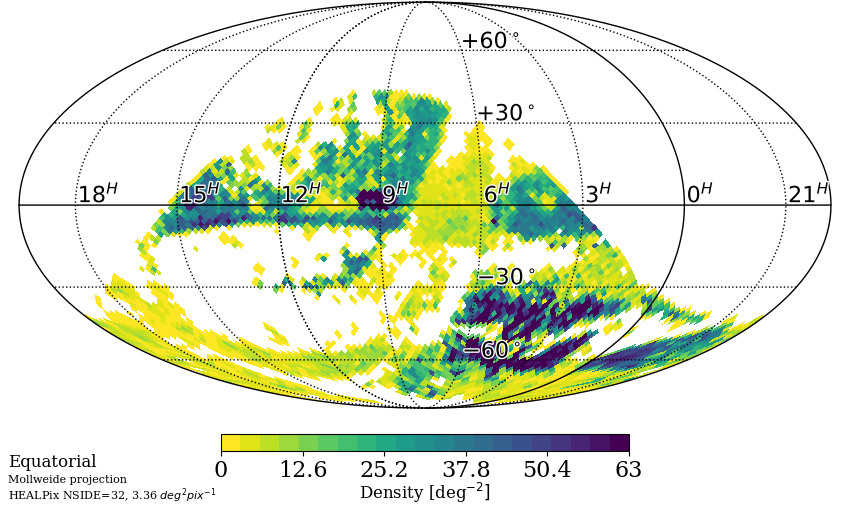
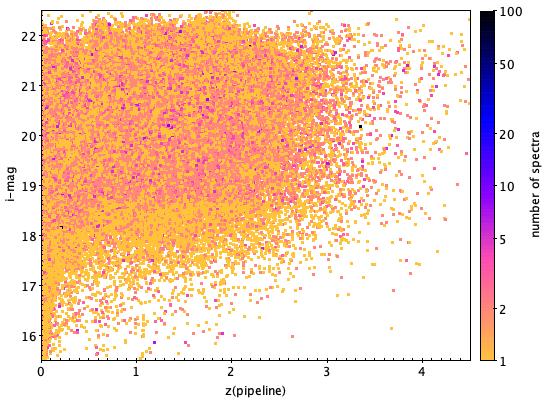
SDSS DR20 contains new optical spectroscopic observations of SPIDERS hemisphere targets (eRASS:3), collected during main phase SDSS-V FPS operations at both APO and LCO (up to Feb 2025).
SDSS DR20 also contains re-reductions of previously released optical (BOSS) spectroscopic data for (primarily) X-ray selected targets observed during the early SDSS-V FPS and plates phases. Those data were previously released and documented in SDSS DR18 and SDSS DR19. Please refer to Aydar et al. (2025) and the associated Value Added Catalogue for more details of the SPIDERS/eFEDS sample.
In general, SDSS spectroscopic observations of a field may be obtained over several nights. Targets may also be assigned cadences that deliberately break the observations into more than one ‘epoch’. For example, many SPIDERS targets are associated with a ‘dark_2x2‘ cadence (two epochs with two exposures each). The DR20 BOSS data reduction process includes a specialized ‘allepoch’ spectroscopic co-adding algorithm, triggered for selected target categories, including any targets that are associated with at least one SPIDERS carton. The ‘allepoch’ 1D spectra (and spectral parameters derived from them) combine all available BOSS data per target (although plate and FPS data are treated separately), and so are often the highest SNR and most appropriate data product for SPIDERS science. In addition, ‘daily’ and ‘epoch’ coadded spectra are also made available for all targets (including SPIDERS targets), which may be interesting for time domain studies.
The number of SPIDERS AGN and clusters spectra in DR20 are given in the tables below. Note that hyphens were used in early plate-era carton naming, but these have been replaced with underscores (for consistency with the later FPS era carton naming scheme).
| (First)Carton name | Ndaily | Nepoch | Nallepoch | Unique targets |
|---|---|---|---|---|
| bhm_spiders_agn_lsdr10 | 192416 | 184639 | 103975 | 107889 |
| bhm_spiders_agn_lsdr10_d3 | 39317 | 38421 | 36437 | 36630 |
| bhm_spiders_agn_lsdr8 | 27619 | 21792 | 10780 | 13399 |
| bhm_spiders_agn_efeds | 17521 | 12434 | 7453 | 9003 |
| bhm_spiders_agn_gaiadr3 | 16528 | 16170 | 10464 | 11290 |
| bhm_spiders_agn_ps1dr2 | 4842 | 4030 | 2193 | 2672 |
| bhm_spiders_agn_efeds_stragglers | 3133 | 2282 | 1839 | 1913 |
| bhm_spiders_agn_gaiadr2 | 2711 | 2679 | 1672 | 1902 |
| bhm_spiders_agn_gaiadr3_d3 | 2515 | 2451 | 2212 | 2226 |
| bhm_spiders_agn_supercosmos | 1771 | 1605 | 1170 | 1208 |
| bhm_spiders_agn_sep | 695 | 526 | 320 | 324 |
| bhm_spiders_agn_hard | 619 | 605 | 397 | 447 |
| bhm_spiders_agn_tda | 403 | 389 | 285 | 298 |
| bhm_spiders_agn_skymapperdr2 | 167 | 159 | 118 | 128 |
| bhm_spiders_agn_hard_d3 | 52 | 50 | 46 | 46 |
| bhm_spiders_agn_tda_d3 | 32 | 32 | 30 | 30 |
| (First)Carton name | Ndaily | Nepoch | Nallepoch | Unique targets |
|---|---|---|---|---|
| bhm_spiders_clusters_lsdr10 | 26622 | 25737 | 15154 | 15249 |
| bhm_spiders_clusters_lsdr10_d3 | 7941 | 7782 | 7491 | 7510 |
| bhm_spiders_clusters_efeds_ls_redmapper | 3077 | 2137 | 1595 | 1630 |
| bhm_spiders_clusters_lsdr8 | 3044 | 2396 | 1428 | 1519 |
| bhm_spiders_clusters_efeds_sdss_redmapper | 1695 | 1147 | 850 | 858 |
| bhm_spiders_clusters_ps1dr2 | 1411 | 1183 | 755 | 770 |
| bhm_spiders_clusters_efeds_hsc_redmapper | 1341 | 888 | 647 | 686 |
| bhm_spiders_clusters_efeds_stragglers | 415 | 279 | 241 | 241 |
| bhm_spiders_clusters_efeds_erosita | 28 | 16 | 12 | 12 |
SPIDERS spectra from FPS commissioning
SDSS DR20 also contains spectra for a small number of FPS science commissioning targets, which can be identified by FIRSTCARTON = "manual_bhm_spiders_comm" or "manual_bhm_spiders_comm_lco". These are all SPIDERS targets in the eFEDS field for which we had previously determined secure spectroscopic redshifts (see Aydar et al. 2025). They were observed as part of the FPS science commissioning phase to verify that fully processed FPS spectra could be used to recover their known redshifts.
Back to Black Hole Mapper Science Programs